Operating agreement template vs custom
Summary: Templates are free or cheap and cover the basics. Custom agreements run $500 to $2,000 and get drafted for your specific situation. Most single member LLCs do fine with a template. If you have a multi member LLC with complex ownership, investors, or buy sell needs, pay for a custom agreement. Saving $500 on legal fees can cost you thousands in a dispute.
Contents
Here's the thing: most founders use a template operating agreement because it's free. Their formation service hands them one. They sign it, file it, and never think about it again. That works fine until it doesn't.
Templates are generic. They assume a standard structure. They don't account for special allocations, tiered distributions, or buy sell triggers. If your LLC is simple, a template is enough. If your LLC is complex, a template is a liability.
The real question is: how complex is your LLC? And how much are you willing to pay to protect it?
Quick comparison
| Factor | Template | Custom |
|---|---|---|
| Cost | $0-$100 | $500-$2,000+ |
| Time to Draft | 15 minutes | 1-2 weeks |
| Customization | Fill in the blanks | Written for your situation |
| Protection | Basic | full |
| Buy-Sell Provisions | Generic (or missing) | Specific to your business |
| Vesting Schedules | Rarely included | Included |
| Enforceability | Questionable in disputes | Strong in disputes |
| Best For | Single-member LLCs | Multi-member LLCs with complexity |
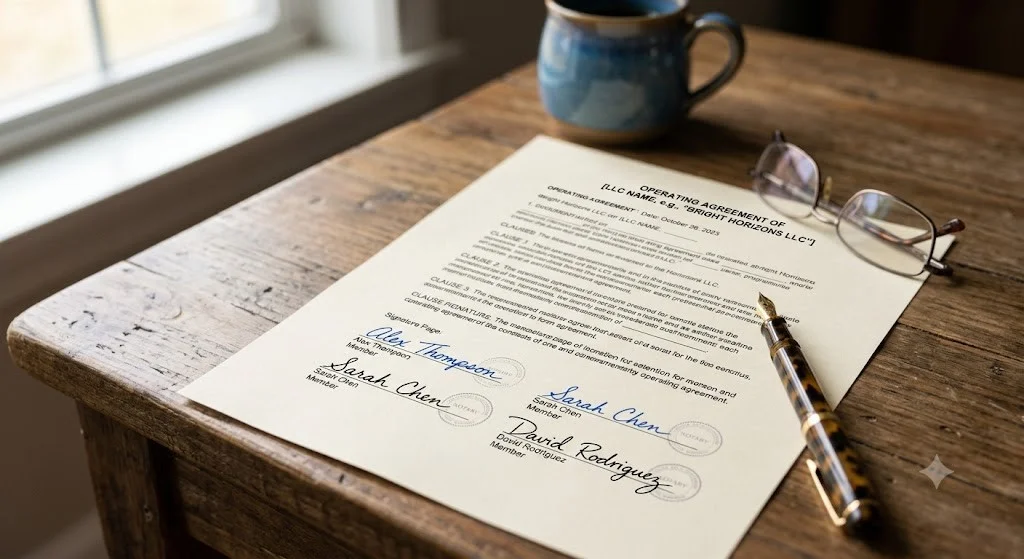
What goes in an operating agreement
An operating agreement is the internal rulebook for your LLC. You don't file it with the state. It's a private contract between the members. Even so, it's the document that governs everything. Who makes decisions. What happens when someone dies.
Standard sections:
- Ownership percentages and capital contributions
- Voting rights and decision-making authority
- Profit and loss allocation
- Distribution policy
- Management structure (member managed or manager managed)
- Buy-sell provisions (what happens when a member leaves)
- Dissolution procedures
- Succession planning
Whether you need an operating agreement isn't really a question. You do. But how complex it gets depends on your situation.
If you're running a single-member vs multi-member LLC, the operating agreement looks completely different. A single-member LLC needs something simple. A multi-member LLC needs something robust.
The template option
A template operating agreement is basically a fill in the blank document. You download it, fill in the basic fields, and everyone signs. Most formation services give you one for free. Some charge $20 to $50 for a premium version.
Where templates come from:
- Formation services like ZenBusiness and Bizee throw one in with their free packages
- Legal sites like Rocket Lawyer have templates you get with a paid membership
- State bar associations sometimes give out free templates
- Nolo sells template packages. So do other legal publishers.
What templates cover well:
- Basic ownership percentages
- Standard voting rules
- Profit and loss allocation
- Basic management structure
What templates miss:
- Custom vesting schedules for founders
- Tiered distribution waterfalls
- Special tax allocations
- Complex buy-sell triggers
- Rights of first refusal
- Drag-along and tag-along rights
- Non-compete and non-solicit clauses
If you're forming a simple LLC with one member, a template is fine. Can you start a LLC yourself with a template? Yes. You don't need a lawyer for basic documents.
If you're forming a multi member LLC, be careful. Templates don't handle the hard cases. Questions to ask a business partner before forming a LLC covers the talks you need to have. Put those talks in writing in your operating agreement.
The custom option
A lawyer drafts a custom operating agreement for your specific situation. It's not a template. It's a document built around your ownership structure, management style, and business goals.
Why founders pay for custom work:
- Complex ownership. Maybe people put in different amounts. Or sweat equity. Or convertible notes. You'll need custom language for that.
- Investor requirements. Raising capital? Investors are going to want specific protections in the operating agreement.
- Buy-sell triggers. Custom agreements can spell out what happens when a member dies, quits, or gets divorced.
- Vesting schedules. Most startups vest founders over several years. Templates hardly ever include that.
- Tax planning. Special allocations and distribution waterfalls need custom drafting.
- Every state has its own rules. Places like California and New York have requirements a template might not cover.
What a lawyer will do:
- Interview you and your partners about your goals
- Review your ownership setup and what everyone brings to the table
- Draft an agreement that fits your situation
- Explain what each clause means
- Revise it based on what you told us
- Sign off on the final version
If you're setting up a multi member LLC and the ownership gets complex, you'll want to document whether it's member managed or manager managed in your operating agreement. Member managed vs manager managed LLC is a call worth getting right. A lawyer can help you think it through.
If you're splitting ownership unequally, how to split ownership percentages needs to be in writing. That's what a custom operating agreement is for.
When templates fail
Templates break in some situations. These are the ones we see most:
1. Unequal contributions. Say one partner puts in $50,000 and the other puts in $5,000. A 50/50 split doesn't make sense there. Yet templates often default to equal splits. A custom agreement lets you set a fair split based on what each person contributes and the work ahead.
2. Vesting schedules. Bringing in a partner who earns equity over time? You need a vesting schedule. Templates hardly ever include one. Without it, your partner could quit after a month and walk away with their full stake.
3. Death or disability. What happens if a member dies? Does their spouse inherit their stake? Can the rest of the members buy it out? Templates hardly ever cover this in detail. A custom agreement can lay out a clear process.
4. Buy-sell triggers. What happens if a member wants to sell? Or they get divorced and their ex claims a stake? What if they go bankrupt? Custom agreements spell out these triggers. Templates don't.
5. Dispute resolution. What happens when members disagree? Do you go to mediation? Arbitration? A buyout? Templates usually leave this out. Custom agreements spell it out.
6. Non-compete and non-solicit. If a member leaves, can they start a competing business? Can they poach your clients? Custom agreements can include non-compete and non-solicit clauses that actually hold up. Templates rarely do.
If you use a service with a template, our LegalZoom review covers what they offer. But even LegalZoom's template isn't custom. It's a template with fill in the blanks.
Online LLC service vs local lawyer covers the bigger question of when a lawyer is worth it. The operating agreement is one of the main reasons to hire one.
Cost comparison
| Option | Cost | Time | Protection |
|---|---|---|---|
| Free template (formation service) | $0 | 15 minutes | Basic |
| Premium template (LegalZoom, Rocket Lawyer) | $50-$100 | 30 minutes | Basic+ |
| Online legal service (custom-ish) | $200-$500 | 1-2 hours | Moderate |
| Local lawyer (simple) | $500-$1,000 | 1-2 weeks | Strong |
| Local lawyer (complex) | $1,500-$2,500+ | 2-4 weeks | full |
The cost difference is huge. A free template costs $0. A custom agreement runs $500 to $2,500. But a bad agreement costs way more. A lawsuit between partners can hit $50,000 or more. A messy buyout can cost even more.
If you're building a business with partners, think of the custom operating agreement as insurance. It's not fun to pay for. But it's way cheaper than the alternative. Every cost of starting a LLC should include legal fees in your budget if you have partners.
The hybrid approach
You don't have to pick between a free template and a $2,500 custom agreement. There's something in between.
- Start with a template. Grab the free template from your formation service and use that as your starting point.
- Customize the important parts. Focus on the sections that matter most for your situation.
- Have a lawyer look it over. Pay $300 to $500 for a lawyer to review your customized template and flag any issues.
- Revise and sign. Make the changes your lawyer recommends, then finalize the document.
This gives you the cost savings of a template, plus the legal review of a custom agreement. For a lot of founders, that's the sweet spot.
Got a service with legal consultations? Use it. LegalZoom and Rocket Lawyer both give you attorney access in their premium packages. LegalZoom vs Rocket Lawyer breaks down the two.
If you're putting together a multi member LLC and want to start from a template, comparing Inc Authority vs ZenBusiness can help you find a service that gives you a decent one. Both throw a template into their free formation packages.
Which one makes sense for you
Use a template if:
- You're a single-member LLC
- You've got simple ownership. Equal splits. No vesting.
- You're not raising outside capital
- You're in a simple state with standard rules
- You want to save money and keep things simple
Pay for a custom agreement if:
- You have several members, and their contributions aren't equal
- You're bringing in partners with vesting schedules
- You're raising money from investors
- You've got complex buy-sell needs
- You want non-compete and non-solicit clauses that hold up
- You're in a state with a lot going on, like California or Massachusetts
- You want peace of mind. You need to know your agreement holds up.
Still not sure? Ask yourself this. "If my partner and I have a falling out, will this agreement protect me?" If the answer's no, you need a custom agreement. If it's yes, a template works fine.
One last thing: if you're setting up a multi member LLC, member-managed vs manager-managed LLC changes what goes in your operating agreement. A lawyer can help you pick the right structure and draft the agreement to match.
Also, if you're setting up a Series LLC vs standard LLC, the operating agreement gets more complex. Series LLCs need separate agreements for the parent and each series. Don't use a template for that.
Already formed your LLC with a template? You can upgrade later. Just amend your operating agreement to add custom provisions. That costs less than starting over. How to keep your LLC compliant walks you through the amendment process.
Frequently asked questions
It depends on your situation. If you have a single member LLC, a template usually works fine. But if you've got multiple members, complex ownership, investors, or buy sell needs, you should get a custom agreement.
Custom operating agreements run $500 to $2,500, depending on how complex they are. Simple ones are around $500. if you're looking for investor protections, expect $2,000 or more.
Yes. You can download a template and fill it in yourself. No law says a lawyer has to draft it. But if ownership gets complex, a lawyer is worth the money.
Yes, as long as it's signed the right way and doesn't go against state law. Templates might miss edge cases, though. If a dispute comes up, a custom agreement is more likely to protect you.
Yes. You can change your operating agreement whenever you need to. Most changes need a member vote. Started with a template? You can move to a custom agreement later.