How to split LLC ownership percentages
Contents
Figuring out how to split equity between founders is one of the biggest calls you’ll make when forming a LLC. A lazy 50/50 split, with no way to adjust things later, can easily turn into a stalemate, bad blood, and expensive legal fights. Do you need an operating agreement for your LLC? Yeah, you do, and it needs to spell out exactly how ownership is set up and kept safe.
Unlike traditional corporations tied strictly to share counts, LLCs give you a ton of structural flexibility under state law. Members can split up operational control, profit distributions, and capital contributions however they want. The Delaware Limited Liability Company Act states: "a LLC agreement may provide for the allocation of profits and losses among members in any manner agreed upon, and such allocations need not be proportionate to capital contributions."
The trap of equal 50/50 splits
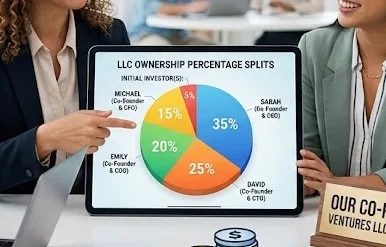
Co-founders usually go with an even split, like 50/50 for two or 33/33/33 for three, just to keep things friendly or dodge a weird talk. But contributions almost never match up evenly over time, skills, risk appetite, or money. How to avoid administrative dissolution often comes down to clear governance rules, and that starts with how you set up ownership.
The Deadlock Hazard. In a 50/50 LLC without special voting rules in the Operating Agreement, neither member can get a majority vote on big strategic calls like taking out loans, signing contracts, or hiring people. Deadlocks that drag on often push companies into court ordered dissolution, which wipes out the business's value. The New York Limited Liability Company Law puts it this way: "Without an operating agreement, LLC fights fall back on default state rules, and those rules might not match what the members actually want."
The Unequal Contribution Reality. One founder might put in cash and work full-time. Another might just bring a great idea and little time. Equal splits ignore that, and they often breed resentment when the founder doing more feels underappreciated.
full contribution valuation models
To split things fairly, founders need to weigh contributions in four main areas. How much money you need before filing a LLC matters, but sweat equity and IP count just as much when figuring out who owns what.
Capital Contributions. Direct financial investments like cash, machinery, real estate, and personal loan guarantees carry immediate, measurable risk. Capital contributions are often weighted with higher priority or structured via preferred returns before operational profits are distributed.
Sweat Equity & Time Commitment. We think a founder putting in 60 hours a week deserves way more weight than an advisor who chips in 10 hours a month and keeps their day job. You have to look at what each person actually gives up to join the LLC. Like, leaving a fat corporate paycheck is a totally different sacrifice than coming in fresh out of school.
Intellectual Property & Domain Expertise. Codebases, proprietary algorithms, design patents, or trade secrets developed before you form the LLC should be formally assigned to it in exchange for an agreed valuation or equity stake. And your industry networks, the ones that bring in clients right away, open up supply chains, or land early distribution deals, they have real commercial value too.
Structural equity models
When you’re setting up LLC ownership percentages, founders usually pick from three main models. Inc Authority can help you get formed, but your operating agreement has to spell out which equity model you’re going with.
Static Fixed Split Model. Percentages get set at the start and stay put unless everyone agrees to change the Operating Agreement. Works best when you’ve got clear, upfront capital and a predictable long game. The catch? It’s rigid if a founder pulls back or underperforms down the road.
Dynamic "Slicing Pie" Model. This one comes from equity strategist Mike Moyer, and it's all about keeping score based on what people actually put in over time. Every hour you work gets valued at a fair market rate, and every dollar you invest turns into slices, or points. The equity split just recalculates on its own until the business hits cash flow positive or lands a real funding round. It works best for early stage startups where roles, money needs, and time commitments are shifting all the time.
Vesting Equity Schedules. Vesting means you earn your equity over time, not all at once on day one. With a standard 4-year schedule and a 1-year cliff, nothing vests in the first 12 months. Leave before that year, and you walk away with zero. Hit the 12-month mark, and 25% vests right then. The other 75% trickles in monthly over the next three years.
Decoupling equity, profits, and voting rights in a LLC
One of the coolest things about a LLC is that your ownership percentage doesn’t have to match your profit share or voting power. Comparing Inc Authority vs. ZenBusiness can help you pick a formation service, but your operating agreement is where you actually set those separate rights.
Capital Percentage. Based on initial cash and asset contributions. An investor could hold 60% capital percentage until their initial investment is repaid.
Profit Distributions (Economic Split). Default is pro-rata based on ownership percentage. But special allocations can structure an investor getting 80% of profits until ROI is met, then adjusting to 50/50.
Voting Rights (Governance). Default is pro-rata based on ownership percentage. But you can structure non-voting units or manager-managed LLCs where operating founders retain 100% voting control while passive investors hold non-voting economic units.
Key clauses to include in the operating agreement
To keep equity disputes from grinding your business to a halt, the Operating Agreement has to spell out protective clauses clearly. How to keep your LLC compliant means having an operating agreement that actually tackles these problems head on.
Buy-Sell Agreement / Texas Shootout Clause. A way to break a tie. One member names a price to buy the other out. The other member has to take that offer or flip it and buy the original member out at the same number.
Anti-Dilution & Capital Call Rules. Defines what happens when the business needs more cash. If a member can't chip in their share during a mandatory Capital Call, their ownership stake shrinks based on a set formula.
Drag-Along and Tag-Along Rights. Drag-Along lets majority owners force minority owners to sell too, when a buyer wants the whole company. Tag-Along protects the minority folks, letting them jump into a sale if a majority owner sells their share to someone else.
IP Assignment & Non-Compete Covenants. We make sure everything you build stays with the LLC, and if you leave, you can't just spin up a rival shop using our stuff.
Tax implications of equity allocations
Profits Interests vs. Capital Interests. When you’re granting equity to a key employee or a co-founder who joins after you’ve already formed the company, a Capital Interest gives them an immediate right to the existing net assets if you liquidate, and they’ll owe taxes right away on the fair market value. A Profits Interest, though, only gives them a right to future appreciation and profits. If you structure it right under IRS Revenue Procedures 93-27 and 2001-43, granting a profits interest isn’t a taxable event when they get it.
Section 83(b) Election. If a LLC is taxed as a Corporation and grants restricted equity subject to vesting, recipients should evaluate filing a 83(b) election with the IRS within 30 days of grant to pay income taxes on current valuation rather than future appreciated values at vesting.
Frequently asked questions
There’s no one size fits all split. It really comes down to who put in what capital, how much time each of you can give, and whose ideas or IP matter more. A lot of folks just go 50/50, with a four year vest and an one year cliff. That’s fine, but you should think about adding something to break ties. Maybe a casting vote, or a shotgun clause. Otherwise you could hit a deadlock and get stuck.
Yes, it’s possible, but you’ll need to amend your Operating Agreement, and that takes consent from every member. You’ve got to get it in writing and have everyone affected sign off. Some agreements already have clauses that allow automatic changes based on capital calls or hitting certain performance milestones.
Your Operating Agreement should define this. You might use a buy-sell agreement, where the remaining members buy out the departing founder’s shares at a set valuation. Or you could go with a vesting schedule, where unvested equity just gets forfeited when someone leaves.