Every cost of starting a LLC
Contents
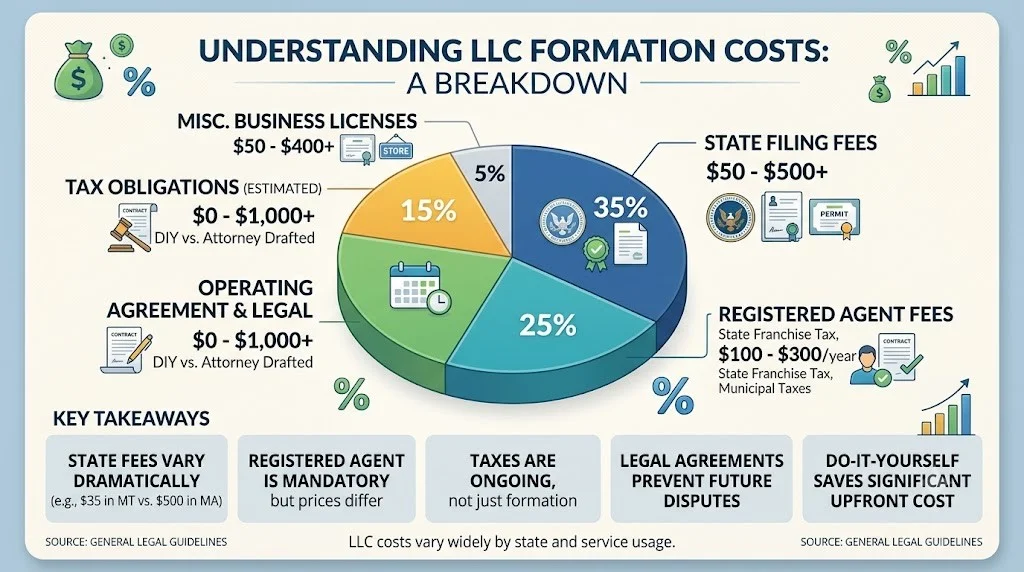
What does it really cost to start a LLC? There’s no single answer, but we can get close. It mostly comes down to your state and whether you hire a formation service. We’ve watched folks launch one for under $100, while others dropped more than $2,000 in year one.
Here's the Analysis. We're gonna sand down every expense, from mandatory state fees to the hidden costs that trip people up.
1. Mandatory state costs (the fees you can't avoid)
These are the baseline fees set by state legislatures. You’ve gotta pay them to get your LLC formed. No way around it.
Articles of Organization Filing Fee: That's the big one. It runs from $35 in Montana up to $500 in Massachusetts, though most states land around $100 to $150. California only charges $70 to file, but they get you later with the franchise tax. The California Secretary of State site puts it this way: "The filing fee for Articles of Organization is $70. All LLCs, regardless of income, are subject to a $800 annual franchise tax."
Name Reservation (Optional): Want to lock in a name before you file your Articles? It’ll cost you $10 to $50. Most folks skip it if they’re filing soon, though.
Publication Requirements: A few states still have odd, old school rules about putting a notice of your formation in a local paper. New York (LLCL § 206) makes you do this: "Within 120 days after the filing of the articles of organization, the LLC shall publish a copy of the articles of organization or a notice... in two newspapers." That'll run you anywhere from $300 to over $1,500, depending on the county.
2. Recurring annual costs (the price of staying alive)
Forming the LLC is step one. Keeping it alive? That’s a whole other expense line.
Annual Report / Information Statement: Most states make you file a report every year or two just to confirm your business info. Some states, like Ohio and Arizona, charge $0 for it. Others, like Massachusetts, hit you with $500 a year. The average runs about $50 to $100. The Texas Secretary of State website puts it this way: "a LLC must file a Public Information Report with the Comptroller of Public Accounts annually."
Franchise Tax / Privilege Tax: This one’s for the right to do business in a state, and it’s separate from income tax. California really stands out here, with a $800 minimum annual franchise tax that you owe even if you don’t make a dime. Delaware keeps it flat at $300 a year. Nevada charges $350 for their list and business license.
Registered Agent Service: You can be your own agent for free if you have a physical address in the state. But if you value privacy, or just don't want your address on public record, you'll pay for a service. Prices run from $100 to $300 a year.
3. Hidden costs & surprises (the ones you don't see coming)
This is where it gets dicey. A lot of founders assume they're done once they pay that state fee, and then a year later, boom, a letter shows up with a fine.
Late Filing Penalties: States don’t mess around here. File your annual report late and you’ll face a late fee, usually $50 to $200, plus your business can lose its “good standing” status. That can block you from getting loans or signing contracts.
Municipal Business Licenses: Your city or county could ask for a general business license. Those usually run $50 to $400 a year. But if you're in something regulated, like construction or food service, you'll need extra permits, and those can hit $200 to $2,000 or more.
Operating Agreement Costs: You need this document. If you don't have one, you're taking on huge liability. Most formation services include a basic one for free. But if you hire a lawyer to draft a custom one for a complex multi-member business, you could spend $800 to $2,500.
4. What you pay for a formation service
This is the part we get asked about most. Should you use a service, or file yourself? Here's how the math works out.
| Service | State Fee (paid separately) | Service Fee | First-Year RA Included |
|---|---|---|---|
| Inc Authority | Yes | $0 | Yes |
| ZenBusiness | Yes | $0+ | No (add-on) |
| Bizee | Yes | $0+ | No (add-on) |
| Northwest | Yes | $0+ | No (part of package) |
| LegalZoom | Yes | $79+ | No (add-on) |
Here's the thing: most services don't charge you a dime for the filing itself, they make their cash on upsells. We like Inc Authority for that because they throw in the registered agent service for the whole first year, free. That's a $100 to $300 value they're just giving away. Solid pick if you want to keep your address private from day one.
ZenBusiness and Bizee have a "free" basic package, but you still pay for the registered agent. Northwest throws the agent in, though their plans kick off a bit higher. LegalZoom’s the priciest of the bunch, with a service fee on top of state costs, and they get you for the agent separately as well.
If you decide to file yourself, you can do it right on your Secretary of State's website. It's usually cheaper. But if you mess up the paperwork, you're on your own. The service providers handle that for you, and they throw in stuff like an operating agreement template. It's worth comparing them side by side in our Inc Authority vs ZenBusiness comparison to see which fits your needs.
The IRS is clear on one thing: you don’t need to pay for an EIN. They say, “You may apply for an EIN online at IRS.gov. This service is free.” So any service that charges you for one is just adding a cost you can skip. We dig into that more in our guide on legal protections.
Frequently asked questions
If you’re filing yourself with a free EIN, your first year usually just costs the state filing fee, which runs $100 to $150, plus any annual report fees. Use a service like Inc Authority with free RA, and you’re only paying that state fee. But in pricey states like California, tack on another $800 for the franchise tax.
Online services like ZenBusiness or Inc Authority cost way less than a lawyer. Lawyers often run you $1,500 to $5,000 for the whole setup. Unless you've got a complex ownership structure or serious assets to protect, an online service usually makes more sense.
Montana and Kentucky have the lowest filing fees, at $35 and $40. But what's actually cheapest depends on your total costs. States like Wyoming and Nevada don't have a state income tax, so over time, they might end up cheaper even though you pay more upfront.