Texas vs california llc, tax, asset protection, and structure
Contents
- Series LLC Superpower vs. California's Entity Multiplication Tax Trap
- Franchise Tax Math and Threshold Games
- Veil Piercing & Asset Protection Culture
- Talent, innovation, and what it costs to do business
- Compliance Rhythm & Administrative Burden
- Formation Cost vs. What It Costs Over Time
- Overall Verdict with detail
- Frequently Asked Questions
Texas vs California. The classic LLC showdown. Most people stop at "no income tax vs. $800 franchise tax," but that’s like judging a car by its paint job. The real differences run deeper. We’re talking structural architecture, compliance cadence, the long term economics of scaling. It all adds up differently.
Here are some angles we don’t see talked about much, which cuts past the usual stuff. Want a wider view on how other states stack up? Our Nevada vs Wyoming LLC piece gives you a solid contrast on privacy and asset protection approaches.
1. Series llc superpower vs. california's entity multiplication tax trap
Texas has one of the strongest Series LLC setups out there, with both protected and registered series. You can keep real estate, IP, or separate product lines tucked inside one parent LLC, and you still only file a single franchise tax report.
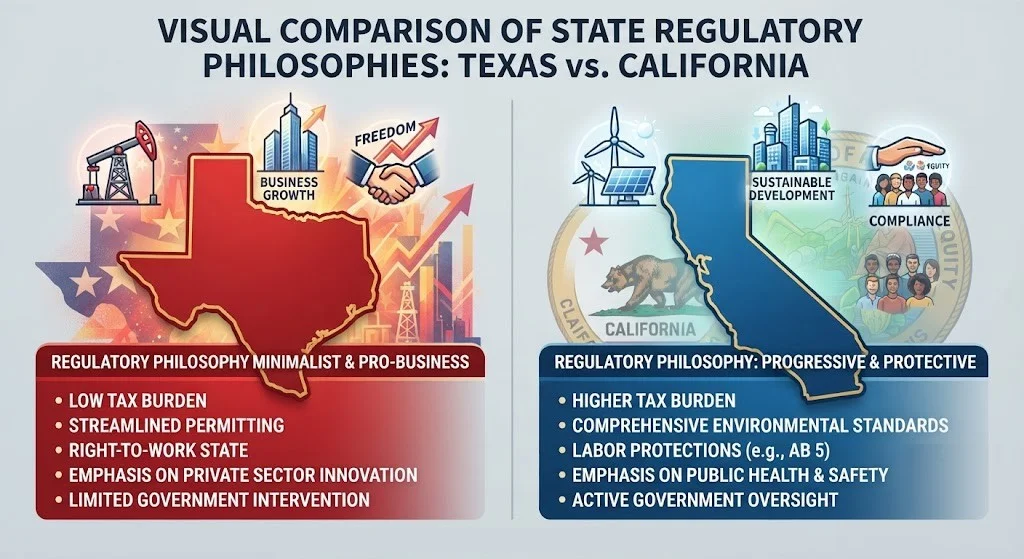
Creative edge most people sleep on: if you run multiple properties or products, Texas lets you scale sideways under one $300 formation plus one PIR/franchise filing. California? Each new entity, or even a foreign qualification, can trip the $800 minimum franchise tax per entity. That makes Texas a structural arbitrage play for asset heavy or diversified operators. One parent, lots of shielded cells, unified compliance.
2. Franchise tax math + threshold games (dynamic optimization)
Texas: $2.65M no-tax-due threshold (2026), and there are a few ways to compute your margin. For retailers, revenue minus COGS usually works best, plus they've aligned bonus depreciation now.
California: $800 minimum franchise tax for LLCs, no matter what you make. Plus gross receipts fees start hitting at lower levels, and their NOL rules are tighter.
Underrated Texas play: time your revenue recognition, use the EZ computation selectively, and layer depreciation elections to stay under the threshold longer while you grow. California makes you pay the $800 floor even at $0 revenue, a silent existence tax that compounds for holding companies or early stage ventures. Texas rewards how you manage revenue. California punishes just being there.
For a deeper look at optimizing your LLC's financial structure, our every cost of starting a LLC article breaks down the full financial picture.
3. Veil piercing & asset protection culture
Texas courts hold you to a strict statutory standard: actual fraud plus personal benefit. Recent Business Court rulings have tossed out loose Delaware style alter ego claims, especially ones built on nothing but undercapitalization or informality.
California generally leans toward plaintiffs, with wider veil-piercing case law.
Strategic angle: Texas builds a reputation as a "fortress jurisdiction." You pair a Texas Series LLC for your core assets with a California entity just for local operations if you're looking for it. That hybrid keeps your overall exposure low while still tapping into CA's talent and market. Not many people talk about using Texas as the "holding fortress" and California as the "operating subsidiary."
For more on protecting your assets, our why a LLC won't protect you from lawsuits article digs into how liability protection varies by state.
4. Talent, innovation, and cost of doing business trade-offs
California wins on ecosystem density, Silicon Valley, Hollywood, biotech. But it loses on cost of living, regulations, and taxes.
Texas has less overall friction. No state income tax, workers' comp is optional in a lot of cases, and there's a business court system. Plus, the sectors are booming. Energy, tech in Austin, logistics.
Creative hybrid most overlook: form the LLC in Texas for the parent or holding structure, since it's cheaper long term and offers better protection. Then foreign qualify in California only if you really need to. That way you dodge California's full $800 plus hit on every entity, but you still get into its market. For remote first or digital businesses, Texas often wins outright. For deep VC or specific industry clusters, a dual structure captures both.
5. Compliance rhythm & administrative burden
Texas: Just one key date each year, May 15 for franchise and PIR. No annual report needed.
California: $800+ every year just to stay in business, biennial statements, tougher employment and labor rules, plus a bunch of local overlays.
Hidden Texas advantage: the simpler cadence frees up founder time and energy for growth, not endless compliance whack-a-mole. In California, that $800 floor plus the publication and qualification hassles create zombie entity problems for side projects or experiments. Texas just makes it easier to try stuff. Lower friction, more experimentation.
For a broader look at compliance, our how to keep your LLC compliant article gives you a solid start.
6. Formation cost vs. lifetime economics
Texas $300 formation costs more upfront, but for most small to medium operations, especially those below the franchise threshold, lifetime costs end up way lower.
California’s lower formation fee? That’s a trap. The real kicker is the recurring $800 plus drag.
Niche insight: For bootstrapped or lifestyle businesses, Texas pays for itself fast. For VC-backed scaling that needs a California presence anyway, the comparison flips, but even then, a Texas parent plus a CA foreign qualification can optimize the structure.
if you're looking for help filing, Inc Authority gives you a free package (you just cover the state fee) and it works well for Texas. ZenBusiness is similar, but their upsells get messy. For a closer look, our Inc Authority review breaks it down.
7. Overall verdict with detail
Texas wins when you care about cost predictability, asset protection, and keeping operations simple. That’s especially true for manufacturing, real estate, energy, logistics, or anything remote or digital. California’s got the edge on raw innovation density and certain ecosystems, but you pay a steep premium for it.
The smartest move in 2026 is usually a Texas-centric setup with some targeted California exposure, not a pick one or the other deal. Run the numbers on your exact revenue model, asset types, and growth plans, and the gap gets way bigger as you scale or hold multiple properties.
For a deeper look at the Texas side of things, our Texas LLC formation article covers the specifics. And for California, our California LLC guide breaks down what that state makes you do.
Texas is the clear winner for most bootstrapped and asset-heavy businesses. California only makes sense if you're looking for direct access to its specific ecosystems and are willing to pay the premium. A hybrid structure (Texas parent + California foreign qualification) often gives you the best of both worlds.
Always check the current thresholds and rules straight with the Texas Comptroller/SOS and California FTB. This isn't an one size fits all thing; it’s a strategic architecture call. For a wider view on starting a LLC, our first 30 days after forming a LLC guide is handy.
Frequently asked questions
Texas generally keeps taxes lower for most LLCs. No state income tax here, and the franchise tax doesn’t kick in until you hit $2.65M. California’s different, though. They’ve got that $800 minimum franchise tax, plus extra fees based on gross receipts.
No. California doesn’t recognize Series LLCs. Texas has one of the strongest Series LLC laws out there.
Texas has a stricter veil piercing standard, so creditors have a harder time getting through the corporate shield. California, on the other hand, usually sides with plaintiffs.
If you have a physical presence or substantial business activity in California, yes. Otherwise, you might not need to. That's a big deal for remote businesses.
The no-tax-due threshold sits at $2.65 million in annualized revenue. Under that, you still file a Public Information Report (PIR), but you don’t owe any tax.