First 30 days after forming a llc, a cheat sheet
Contents
You’ve got your approved Articles of Organization. Congrats. But the work’s just starting. The first 30 days after forming a LLC are when you build the infrastructure that keeps your business legal, protected, and ready to run.
Miss this window, and you risk piercing the corporate veil (that's a fancy way of saying you lose personal asset protection), banking roadblocks, or fines from the state. We've seen folks trip up on all of these.
Here's our week by week roadmap for your first month. It's not glamorous, but it's the foundation that keeps your business from collapsing later.
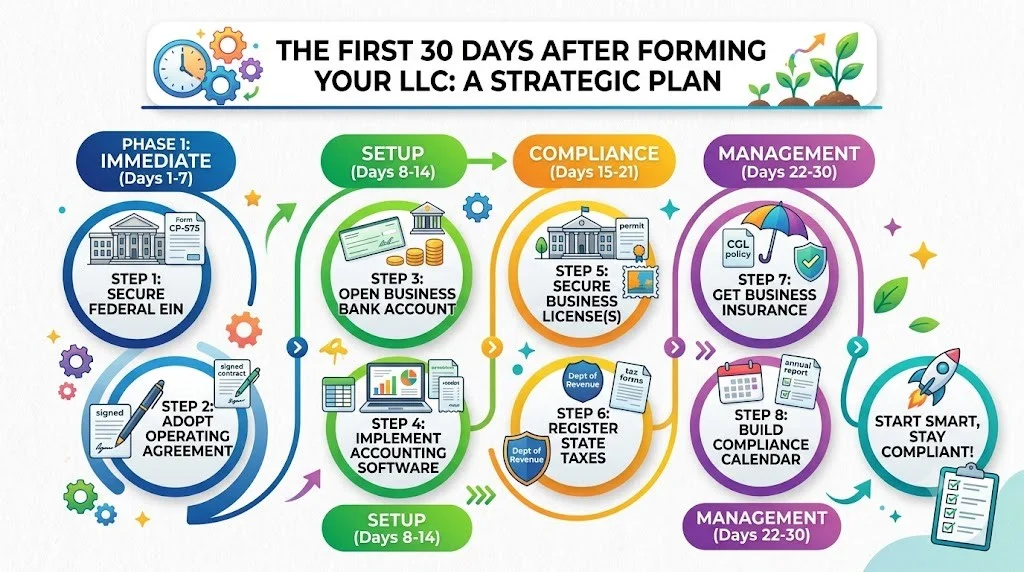
Week 1, legal foundation (days 1-7)
This week’s about getting the government paperwork sorted and making sure the business is a real, separate legal entity.
1. Get Your EIN (Federal Tax ID)
This is your business's social security number. You need it to open a bank account, hire employees, and file taxes. Go to IRS.gov and apply directly. It's free and takes about 15 minutes. The IRS website says: "You may apply for an EIN online at IRS.gov. This service is free."
2. Draft Your Operating Agreement
Even if you're a single-member LLC, you need this. It's the internal rulebook that proves your business is a separate entity. Most formation services include a template. If you used a service like Inc Authority or ZenBusiness, this is usually included for free. If you drafted yourself, you can find templates online, but an attorney is safer for complex situations.
3. Verify Your Formation Documents
Double-check your Articles of Organization from the Secretary of State. Look for any typos in your business name or address. Also, confirm your registered agent is on file and has a physical address in the state. The California Secretary of State advises: "Review your filed documents carefully. Errors can cause delays in future filings."
Week 2, financial setup (days 8-14)
Now you're building the financial walls between you and your business. That's important for liability protection.
1. Open a Business Bank Account
Walk into a bank (or do it online) with your EIN, Articles of Organization, and operating agreement. You need a dedicated business checking account. The California Franchise Tax Board states: "Commingling personal and business funds can lead to personal liability for business debts."
2. Set Up Accounting Software
Grab QuickBooks, Xero, or FreshBooks and get it going. Connect it to your new bank account. That way, you're tracking every dollar from day one. It'll save you a real headache come tax time.
3. Document Initial Contributions
If you or other members put money into the business, record it as a capital contribution. That's your company's starting balance.
Week 3, licenses, permits & state taxes (days 15-21)
This is where people get lazy and it bites them. Your state and local government want their cut, and they want you registered.
1. Register with Your State's Tax Authority
You'll need a sales tax permit if you're selling goods or certain services. And if you're hiring employees, you've got to register for state unemployment tax too. The New York Department of Taxation and Finance says: "All businesses selling tangible personal property must register for a Certificate of Authority."
2. Get a Local Business License
This one's usually handled by your city or county. Costs run from $50 to $400 a year. If you're working from home, check if you're looking for a "home occupation permit." Zoning laws can get tricky.
Week 4, insurance, contracts & compliance (days 22-30)
Final week. You're wrapping up the risk management side of things.
1. Buy Business Insurance
General liability insurance is the baseline. It covers you if someone gets hurt on your property or if you damage someone else's stuff. Professional liability (Errors & Omissions) is for consultants and service providers. Workers' comp is mandatory in most states if you have employees.
2. Standardize Your Contracts
Don’t sign anything as just "John Doe." Use your full LLC name, like "Acme Services, LLC," and your title, say "John Doe, Managing Member." That way, the liability stays with the company, not on you.
3. Set Up Your Annual Compliance Calendar
Put your annual report deadlines, franchise tax due dates, and quarterly estimated tax payments on the calendar. Miss them and it costs you. If you have a registered agent service, they usually remind you. Northwest is known for that, but Inc Authority and Bizee handle it well too.
For more detail on the ongoing costs, check out our guide on every cost of starting a LLC. And if you're thinking about switching agents later, see our guide on how to switch registered agents.
Frequently asked questions
Don't panic. The world won't end. But you might get hit with late fees, usually fifty to two hundred bucks, and you'll lose your "good standing" with the state. That matters for loans and contracts. Honestly, it's way easier to just handle it on time.
Yes. It’s the main document courts check to see if your LLC is actually a real business. Without it, you’re way more exposed to “piercing the corporate veil” and losing that personal asset protection. And it’s free or nearly free, so the upside is massive.
We strongly advise against it. Commingling funds is the number one reason courts strip away LLC liability protection. Get a business account as early as possible. It's cheap and it's the right way to do business.