When to open a business bank account
Contents
Opening a dedicated business bank account is one of the first real steps to building something legit and scalable. It’s not always legally required, but the practical, legal, and tax perks are hard to ignore. How to open a business bank account after forming a LLC walks you through the whole thing.
The U.S. Small Business Administration says, "Open a business bank account as soon as you start taking in or spending money under your business name. That keeps your records straight and shields your personal stuff."
Why separate business and personal finances?
Commingling funds causes a bunch of problems that can wreck both your business and personal money. The top mistakes first-time LLC owners make usually come down to not keeping their finances separate.
Tax and accounting complications. Mixing transactions makes it tough to track deductible business expenses, report income accurately, or get ready for an audit. The IRS watches mixed accounts closely, and the IRS states: "Commingling personal and business funds can jeopardize the liability protection provided by a LLC."
Liability risks. For LLCs and corporations, if you don’t keep things separate, you can "pierce the corporate veil," and then your personal stuff is on the line for business debts or lawsuits. That’s the main reason courts take away that protection.
Professionalism and credibility. Vendors, clients, investors, and lenders see businesses with dedicated accounts as more serious and established. It makes accepting payments and building business credit way easier. Firstrust Bank notes: "A business bank account signals that you're running a professional operation."
Access to services. Business accounts usually come with stuff like invoicing, payroll integration, higher transaction limits, merchant services, and loans. Personal accounts just don't have those.
Key timing considerations
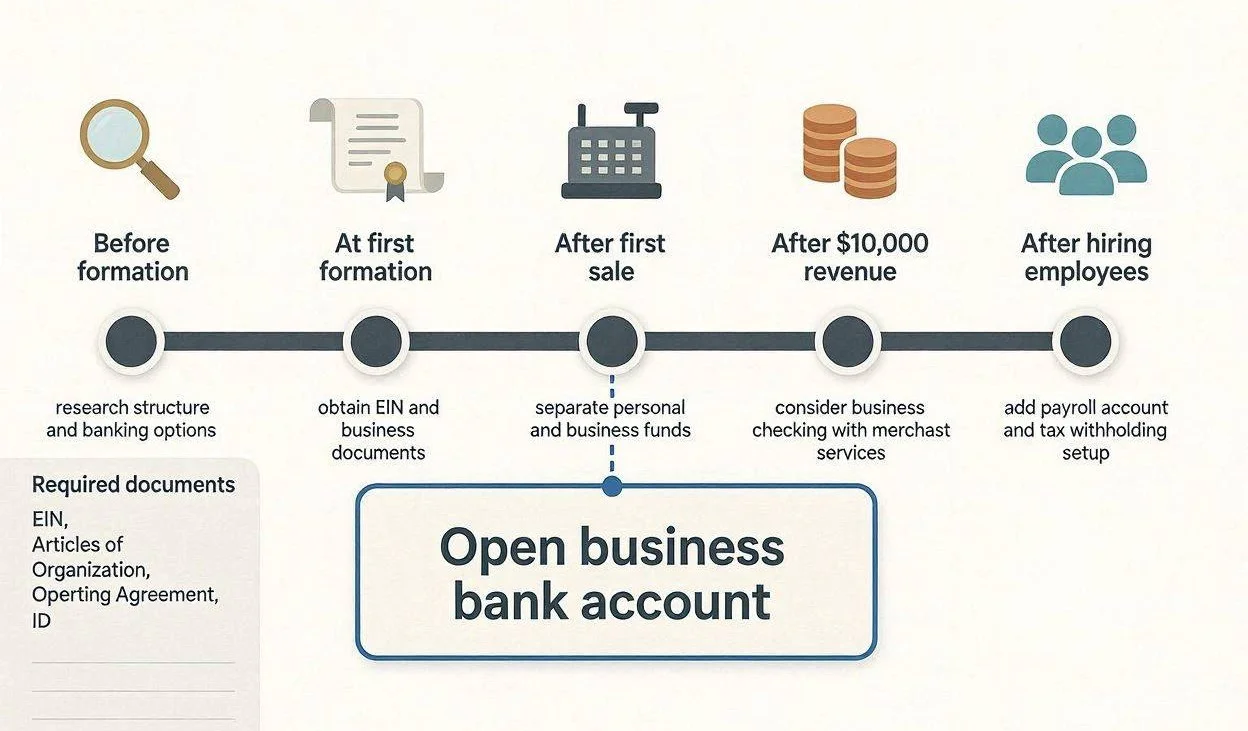
Pre-Revenue or Idea Stage. Lots of experts say wait until you have an EIN or a legal entity set up. Opening too early with zero activity could trigger dormancy fees or even closure. But if you're incorporating or expecting some initial capital from founders or investors, that's a solid time to jump in. When to form a LLC for a side hustle usually lines up with when you actually need that bank account.
When you form or register your business. That's usually the best time. Get your entity set up, grab an EIN, then open the account. Lots of banks want to see those formation documents. For LLCs and corporations, this step really locks in that legal separation. CNBC puts it this way: "Opening a business bank account immediately after formation is a best practice for maintaining liability protection."
When You Start Accepting or Spending Money. Per SBA guidance, open the account as soon as transactions begin. That means receiving client payments, buying inventory, paying contractors, or racking up startup costs you want to track separately. Wait past that, and you're stuck with messy retroactive bookkeeping. The SBA puts it this way: "Open a business bank account as soon as you start accepting or spending money in the name of your business."
Before Major Milestones. Applying for business loans, credit cards, or grants means you need a clean financial history. Hiring employees or contractors gets way easier when payroll and tax withholding are set up right. Accepting credit or debit card payments? You’ll need a business account for that. And if you’re seeking investors, professional financials are what build trust.
For Sole Proprietors. Not legally required in many places, but highly recommended once revenue starts. It simplifies taxes and adds professionalism without the full entity formalities. It's rarely too late, if you've been operating with personal accounts, open one now and begin routing new transactions through it.
Legal and regulatory factors
Requirements vary by country and business type. Can you start a LLC yourself? Yes, but you'll still need a business bank account to keep your liability protection intact.
United States. There’s no federal rule that covers everyone, but banks will want your EIN (or SSN if you’re a sole prop), formation docs, a business license, and your ID. LLCs and corporations get the most out of this separation for liability protection. Just know each state does things a bit differently.
Canada and UK. Similar documentation requirements. Some banks require local presence or directors for foreign-owned entities.
International and Non-Residents. This one gets trickier because of KYC and AML rules. US banks might want a physical US address or a subsidiary for foreign LLCs. Sanctions lists block some countries. So always check local regulations.
Pros and cons of opening early vs. waiting
Pros of Opening Early. Clean records from day one, builds banking relationship and business credit, easier scaling and financing, and professional image.
Cons and Challenges. Potential minimum balance or fees if activity is low, more upfront paperwork, account maintenance if the business pivots or fails. Waiting risks tangled finances, higher accounting costs, and missed opportunities like inability to accept cards easily.
Steps to open a business bank account
Pick the right bank or credit union. Look at fees, features like online banking and QuickBooks integrations, branch access, and minimums. Online banks work well if you're remote or don't need much, but traditional ones give you in-person help and loans. Comparing Inc Authority vs. ZenBusiness can help with formation, though picking a bank is its own thing.
Gather Documents. You’ll need your EIN or SSN, formation papers like articles of incorporation or organization, a business license or DBA certificate, a government-issued ID, ownership agreements if you have partners, and proof of address for both you and the business.
Apply. Online or in-branch. Approval can be quick, often same day, with documents ready. Fund the account to meet any minimum deposit. Set up tools by linking accounting software, ordering checks and cards, and enabling deposits.
Additional Considerations. Look for low or no monthly fees, unlimited transactions, interest on balances, and integrations. Avoid high overdraft or cash deposit fees if relevant. As you grow, consider separate accounts for operations, savings, taxes, or payroll. Online and fintech options like Mercury, Bluevine, and Relay cater to startups with modern tools and low fees. International businesses should factor in currency needs, cross-border fees, and compliance. Review statements monthly, reconcile regularly, and maintain good standing to unlock better services.
Frequently asked questions
Open one as soon as you start taking in or spending money for your business. Ideally, you’ll do it after you form your entity and get an EIN, but before you kick off any transactions.
You can, but you shouldn't. Mixing personal and business money leads to tax messes, hurts your liability shield, and makes tracking performance a pain. A separate business account is key to keeping that corporate veil intact.
Not legally required for sole proprietors, but once you start earning regular income, it's highly recommended. It makes tax filing simpler, looks more professional, and helps you track business expenses for deductions.