How to open a business bank account after forming a LLC
Contents
Forming a LLC legally separates you from your business. But that separation doesn’t fully happen until you open a dedicated business bank account. The hidden risks of sole proprietorship include mixing funds, and LLCs face that same risk if they don’t keep their finances apart.
Mixing personal and business money is the main thing that makes courts toss out your liability protection, which puts your own stuff on the line for business debts. The IRS puts it like this: "Commingling personal and business funds can jeopardize the liability protection provided by a LLC."
Why a dedicated business account is crucial
Opening a business bank account isn't just about convenience. It's a legal and operational must. How to keep your LLC compliant really starts with keeping your money separate.
Preserving Limited Liability Protection. Paying business costs from a personal checking account, or dropping company checks into personal accounts, makes the LLC look like just an extension of you. That lets courts "pierce the corporate veil" and come after your personal stuff. The California Franchise Tax Board notes: "Maintaining separate bank accounts is key to establishing that your LLC is a distinct legal entity."
Streamlining tax accounting and compliance. Mixing personal and business expenses? That’s a fast track to serious tax trouble. When you deduct business costs from a personal account, you’re basically asking for denied deductions if you get audited. Keep things separate and clean, and you’ll cut down on bookkeeping time and what you pay your CPA to prep your taxes.
Commercial Credibility & Payment Processing. Clients and vendors expect to pay a registered company name, not a person. Processors like Stripe, Square, or traditional merchant services need a dedicated business bank account tied to an EIN.
Required documentation checklist
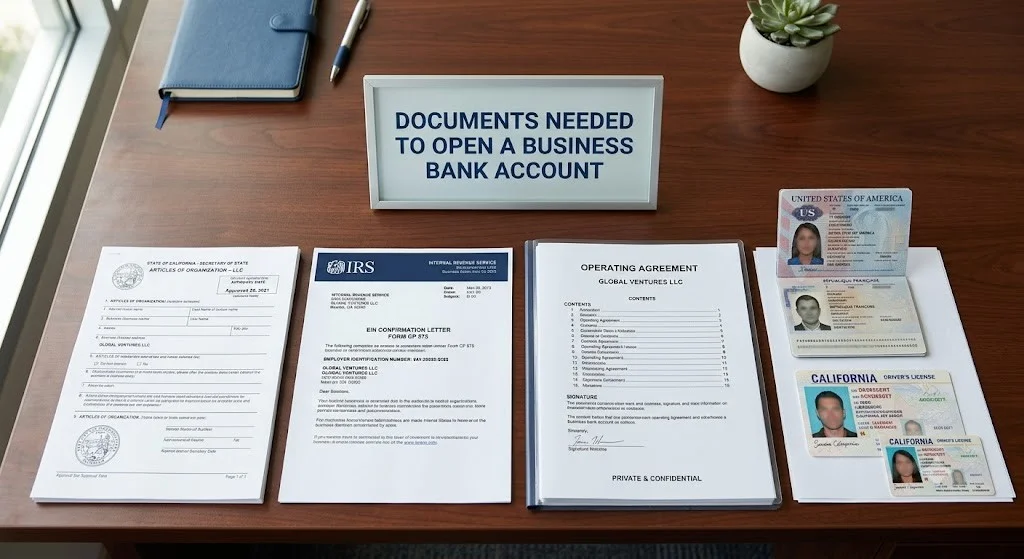
Before you head to a branch or start an online application, make sure you’ve got all the required legal and ID documents together. Your first 30 days after forming a LLC should include getting these sorted for your bank visit.
Articles of Organization (or Certificate of Formation). This is your official state approval document proving the LLC exists. Must show the official state stamp or seal. The Texas Secretary of State states: "A certificate of formation is the document that creates your LLC. Banks require it to verify your business's legal existence."
Employer Identification Number (EIN) Letter. That's the IRS Form CP 575 or 147C confirmation letter that assigns your business tax ID. You can apply for it free at IRS.gov. Don't pay a service for this.
Operating Agreement. This internal document proves ownership structure, member roles, and who can open bank accounts. Even single-member LLCs need it to show the business is a separate entity.
Government-Issued Photo ID. Driver's license or passport for all members or owners with 25% or more ownership stake.
Business License or Permits (if applicable). Some banks need these for certain regulated fields, like food service, retail, or consulting.
Fictitious Name / DBA Certificate (if applicable). You'll need this if your business goes by a trade name that's different from its legal LLC name.
Key factors when selecting a bank
Not every bank gives small businesses the same deal. Pick one that fits how you run things and where you’re headed. Inc Authority can handle the formation, but the bank choice is all yours.
Fee Structures & Waiver Thresholds. Monthly maintenance fees usually run $10 to $30, but banks often waive them if you keep a daily balance of $1,500 to $5,000. Check the free transaction limits for electronic transfers and checks. If you run a physical business, look at cash deposit limits before fees kick in.
Digital Tools & Software Integration. Look for direct integrations with accounting platforms like QuickBooks, Xero, or FreshBooks to automate expense reconciliation. Ensure robust mobile app capability for check deposits, user access controls, and wire transfers.
Credit Lines & Future Lending Needs. If you’re planning to apply for commercial loans, equipment financing, or a business line of credit within the next few years, setting up a checking account with a traditional regional or national bank can make those approvals a lot smoother. Online banks are great for keeping fees low, but they might not give you the same lending options.
Step-by-step account opening process
Here's exactly what to do. Comparing Inc Authority vs. ZenBusiness can help you pick a formation service, but neither one will open your bank account for you.
Step 1: Confirm Official State Approval. Don't apply for a bank account with pending formation paperwork. Wait until the Secretary of State sends back your stamped, approved Articles of Organization.
Step 2: Get an official IRS EIN. You can apply for one online through the IRS portal, and it's free. Don't use your personal Social Security number for a LLC business checking account, even if you're a single member. Banks need the EIN to set up entity accounts the right way.
Step 3: Schedule an Appointment or Apply Online. In-person application is often required if the LLC has multiple members, complex ownership tiers, or handles cash-heavy operations. Online application is ideal for single-member LLCs or digital businesses and requires uploading crisp PDF scans of all required identity and formation documents.
Step 4: Make the Initial Opening Deposit. Move your starting money into the account from your personal checking. Log that transfer as a "Owner Capital Contribution" in your accounting software so your audit trail stays clean.
Post-account setup best practices
Opening the account is only half the process. Managing it right keeps your legal protection and operations running smoothly. How to avoid administrative dissolution means keeping proper financial records that show your LLC is a real, separate entity.
Set Up Owner Draws/Payroll Correctly. For single-member LLCs with pass-through taxation, just move profits from the business account to your personal account and label it a "Owner Draw." If you've elected S-Corp status, run formal W-2 payroll through a payroll provider for officer salaries, then issue separate distributions for whatever’s left.
Issue Dedicated Debit/Credit Cards to Authorized Members. Only hand out cards to team members who are actually allowed to make business purchases. You can set individual spending limits right from your online banking dashboard, which keeps you in control.
Automate accounting reconciliation. Hook your business bank feed straight to your accounting software. Then, at month end, just reconcile everything so no personal charges slipped through by accident.
Establish an Operating Capital Reserve Buffer. Keep a minimum cash reserve (typically 3 to 6 months of fixed operating overhead) in a business savings or money market account to handle seasonal fluctuations without relying on personal funds.
Frequently asked questions
Technically yes, but you absolutely shouldn't. Mixing personal and business money is the top reason courts pierce the corporate veil. You need a separate business account to keep your liability protection and make tax filing way easier.
Yes. Banks need an EIN to open a business account, even if you're a single-member LLC. You can grab one free from the IRS in about 15 minutes. Don't pay some service to do it for you.
It varies by bank. Some online banks let you open with $0. Traditional banks often want $25 to $100 upfront. And a lot of them also expect you to keep a daily balance of $1,500 to $5,000, or you’ll get hit with monthly fees.