Top mistakes first-time LLC owners make
Contents
The LLC is the go to choice for most entrepreneurs. But getting one is so easy that it lulls you into a false sense of security. First time owners skip the important formalities, mess up their taxes, and open themselves up to some serious liability. The hidden risks of sole proprietorship are a lot like the risks of a LLC you don't manage right, and either way your personal assets are on the line.
Failure to follow the rules can get the corporate veil pierced, and that puts your personal stuff on the line for business debts. The California Secretary of State puts it this way: "a LLC that skips the proper formalities might lose its liability shield."
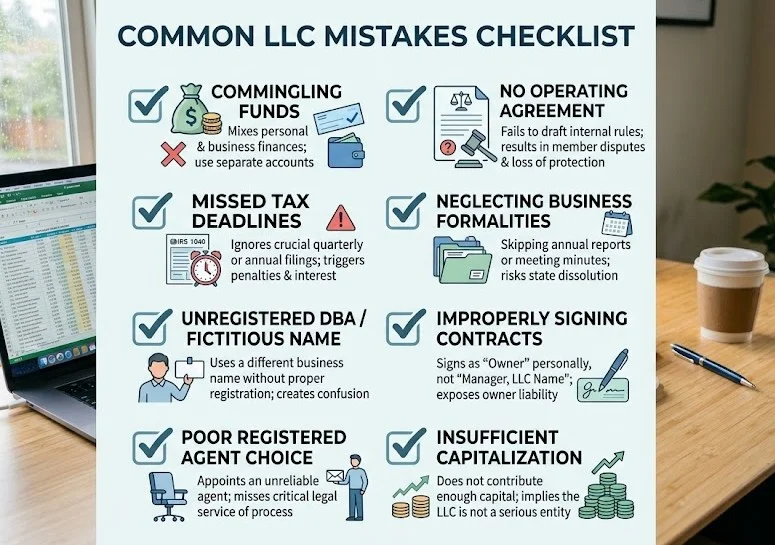
Mistake #1, Commingling Personal and Business Finances
Using a single bank account for both personal and business stuff? That’s the quickest way to blow up your liability protection. How to open a business bank account after forming a LLC is a huge step you can’t skip if you want to stay safe.
The Risk. If a creditor or plaintiff proves you treat the LLC like your own personal "piggy bank," courts will ignore the limited liability shield and hold you personally on the hook for business debts and lawsuits. The IRS puts it this way: "Commingling personal and business funds can jeopardize the liability protection provided by a LLC."
Remediation. Open a dedicated business checking account as soon as you form the company. Don't pay personal stuff from it. Only take money out as a formal owner's draw or set up a real W-2 payroll.
Mistake #2, Operating Without an Operating Agreement
Relying on a handshake or skipping an Operating Agreement is a big mistake. Do you need an operating agreement for your LLC? Always yes, even if you’re the only member.
The Risk. In multi-member LLCs, skipping an Operating Agreement almost guarantees fights you can’t settle, over who gets what profit, who gets to vote, and how buyouts work. For single-member LLCs, it makes it harder to argue you’re a real separate entity, not just your own pocket. The New York Department of State puts it this way: "While an operating agreement is not required to be filed with the Department of State, it is highly recommended for all LLCs."
Remediation. Get a full Operating Agreement in place before you start making money. It needs to spell out capital contributions, how profits get split, who runs things, and what happens if you hit a deadlock.
Mistake #3, Execution of Contracts Under Personal Identity
Signing contracts with just your personal signature instead of one in your representative capacity is a mistake people make all the time, and it can get pricey. Inc Authority can help you set up your LLC, but you've got to make sure you're signing things the right way to keep that liability shield intact.
The Risk. Contract law says that if you sign without stating you're acting for a company, you take on personal liability. Sign as "Jane Doe" instead of "Jane Doe, Managing Member of Acme Ventures LLC," and you're the one stuck with the bill.
Remediation. Make sure every official letter, invoice, site, and contract clearly shows the full legal entity name and a spot for a rep to sign.
Mistake #4, Misunderstanding Self-Employment Tax and S-Corp Timing
Assuming LLC profits are only hit with standard income tax? That’s a pricey mistake. LLC tax surprises for new owners usually boil down to self-employment tax and whether an S-corp election might actually help.
The Risk. LLC owners default to paying a 15.3% Self-Employment Tax on 100% of net profits. For businesses earning significant net revenue, this results in thousands of dollars of unnecessary tax drag. The IRS states: "Self-employment tax is a Social Security and Medicare tax primarily for individuals who work for themselves. The rate is 15.3%."
Remediation. Sit down with a CPA every year to go over your tax strategy. they'll help you figure out if switching to S-Corp status, which lets you split income between salary and distributions, actually cuts your tax bill.
Mistake #5, Ignoring State and Federal Reporting Requirements
Treating LLC formation as an one and done task? That’s a recipe for disaster. How to keep your LLC compliant takes ongoing attention to state and federal filing obligations.
The Risk. Failing to file annual state reports gets you administratively dissolved, you lose good standing, and your liability protection goes out the window. And if you skip federal BOI reports under the Corporate Transparency Act, the penalties get serious, both civil and criminal. The FinCEN puts it this way: "Beneficial ownership information reporting is required for most LLCs. Failure to report can result in penalties of up to $500 per day."
Remediation. Keep a central compliance calendar that tracks state renewal dates and federal obligations.
Additional Mistakes. Calling workers independent contractors when they’re really employees can bring DOL and IRS penalties. Skip foreign qualification in multiple states and you lose the right to enforce contracts, plus you’ll owe back taxes. An unregistered DBA or missing local licenses? That’s cease and desist orders and fines piling up daily.
Frequently asked questions
Technically yes, but you absolutely shouldn’t. Mixing personal and business money is the biggest reason courts pierce the corporate veil. You need a separate business account to keep your liability protection.
Yes. It’s the main document courts check to see if your LLC is a real business. Skip it, and you’re way more likely to get hit with “piercing the corporate veil” and lose your personal asset protection.
Your LLC will lose Good Standing with the state. You’ll get hit with late fees, and if you don’t file in time, the state could dissolve your business. You can get it reinstated, but that’ll cost you more in back fees and penalties.