When to form a LLC for a side hustle
Contents
Forming a LLC for a side hustle is something a lot of freelancers, gig workers, e-commerce sellers, and consultants think about when they’re making extra cash outside their day job. The five signs your freelancing has outgrown a sole proprietorship can help you figure out if you’re ready to take that step.
Chase for Business notes: "Forming a LLC for a side hustle can give you liability protection and a bit of credibility, but you don't always need one. Think about your revenue, your risk, and where you want to go long term before you decide."
Default structure, sole proprietorship
If you start making money on the side without setting up a legal entity, you’re automatically a sole proprietorship. The hidden risks of sole proprietorship include unlimited personal liability, and that’s why a lot of side hustlers eventually go the LLC route.
Taxes. You’ll report income and expenses on Schedule C of your personal Form 1040. If your net earnings hit $400 or more, you have to file. And you’ll pay self-employment taxes for Social Security and Medicare, which comes to about 15.3% on net earnings.
Liability. Unlimited personal liability. Business debts, lawsuits, or claims can hit your personal stuff, like your home, car, and savings.
Simplicity. No formation fees, no annual reports in most cases, setup is easy. That works fine for very low-risk stuff with little revenue, like occasional online sales or hobby gigs. The U.S. Chamber of Commerce says: "A sole proprietorship is the simplest business structure, but it offers no liability protection."
What is a LLC and key benefits for side hustles
a LLC mixes things up: you get the liability protection of a corporation, but the tax flexibility of a partnership or sole proprietorship. Inc Authority is one of a few services that can help you set one up when you're ready.
Liability protection. It keeps your personal and business stuff separate. Lawsuits or debts usually go after the LLC, not you personally, though there are exceptions like personal guarantees, fraud, or mixing funds. That's really valuable for service work, client facing gigs, or anything with injury or property risk. Chase for Business puts it this way: "a LLC can protect your personal assets from business liabilities."
Credibility and professionalism. It signals legitimacy to clients, vendors, or banks. That makes it easier to open a business bank account, build business credit, or land bigger contracts.
Tax flexibility. Default pass-through taxation means profits and losses flow to your personal return. You can elect S-corp status later to save on self-employment tax as profits grow. The Qualified Business Income deduction might knock off up to 20%.
Growth gets easier. Adding partners, hiring, scaling up, it all gets simpler. Finances stay separate, which makes record-keeping cleaner and helps with deductions for your home office, gear, marketing, you name it.
Drawbacks and costs
Formation and ongoing costs. Filing fees run from $35 to $500+ with a national average near $132, and they vary by state. Annual or biennial reports or franchise taxes add $0 to $800+ (California's $800 minimum really stands out). Registered agent fees cost about $100 to $300 a year if you use a service. Every cost of starting a LLC is worth thinking through before you decide.
Administrative burden. Annual filings, separate records, possible state compliance. More complex taxes if income grows.
Self-employment taxes. They still hit you in full with a default single-member setup, unless you go the S-corp route.
Not ideal for all. Overkill for tiny or low-risk hustles. Harder to attract certain investors since LLCs don't issue stock. The California Franchise Tax Board states: "All LLCs doing business in California must pay the annual minimum franchise tax of $800."
When to form a LLC for a side hustle
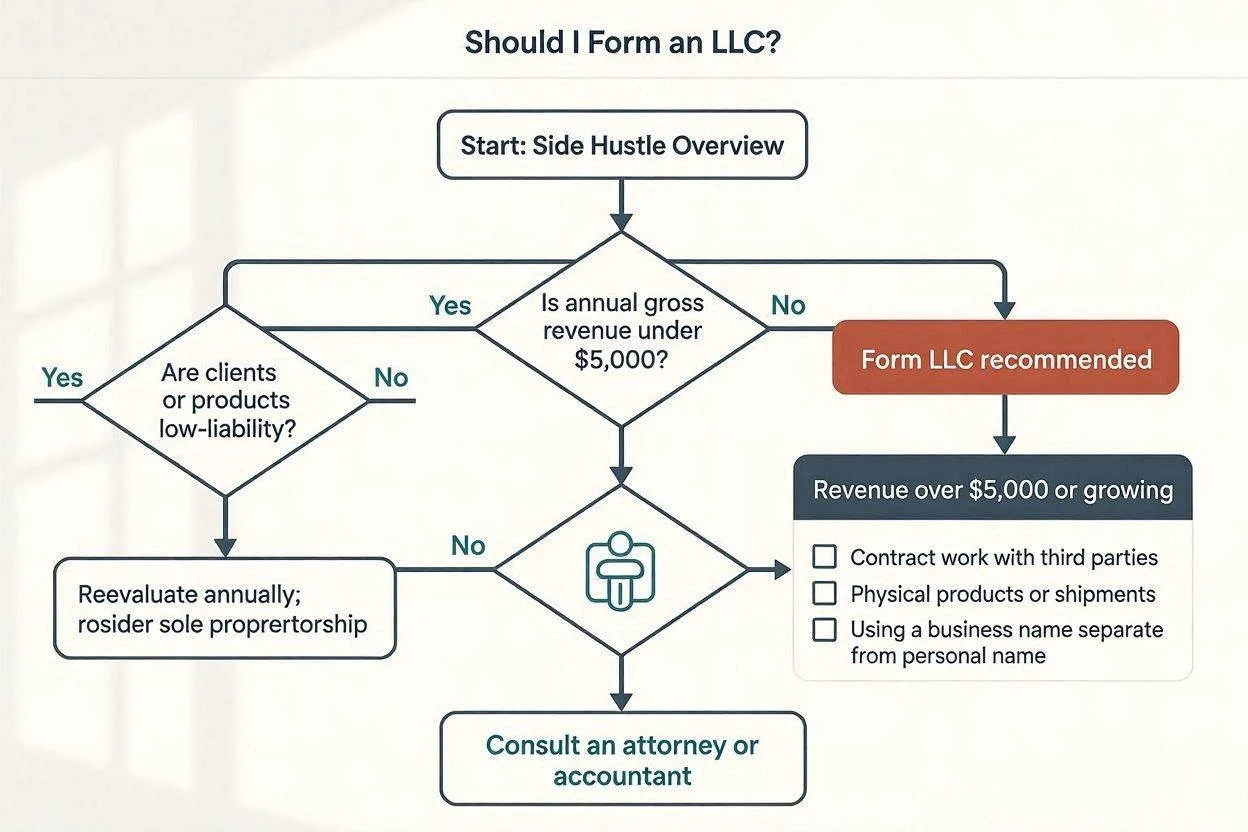
There’s no one size fits all income number here. It really comes down to your risk, your goals, how steady your revenue is, and how much admin or cost you can stomach. How much money you need before filing a LLC isn’t about hitting some magic figure, it’s more about whether the benefits actually beat the costs.
Low urgency (stay sole prop). Occasional income under $1,000 to $5,000 a year net, very low risk like digital products or flipping now and then, testing the idea. Lots of folks start here and switch later.
Consider forming. You’re consistently profitable, maybe $5,000 to $40,000+ a year. You’re doing direct client work or something with more liability, like consulting, services, handmade goods with safety issues, or rentals. You’re using heavy equipment or vehicles, or working on someone else’s property. You’re hiring help or bringing on partners. You’re planning to go full-time or chase loans or credit. You want your finances separate or a more professional look. Rocket Lawyer notes: "Early formation can lock in protection from day one and make growth smoother."
Tax-focused view. Some analyses say you'd break even around $6,500+ in net profit for basic structuring perks, but the real wins kick in at $50,000 to $100,000+, especially with an S-corp election. Talk to a tax pro.
Practical steps to form a LLC
Choose a name that's unique in your state, and it often has to include "LLC." Check if it's available and clear any trademarks. File your Articles of Organization with your state's Secretary of State, then pay the fee. You'll want an Operating Agreement to lay out internal rules. Grab an EIN from the IRS if you're looking for it for banking, employees, or taxes. Register for whatever taxes, licenses, and permits your area and industry require. Open a business bank account and keep your finances separate. Stay on top of annual reports and taxes. Comparing Inc Authority vs. ZenBusiness can help you pick a formation service.
Recommendations and Best Practices. Assess risk first. High-liability stuff warrants earlier formation plus insurance. Talk to a CPA or tax advisor about your income and situation. Start simple and scale smart. Test things as a sole prop, then form a LLC when you need it. Keep funds separate, always. And think about insurance as a complement or even an alternative to a LLC.
Frequently asked questions
Consider forming a LLC once your side hustle brings in steady money, like $5,000 to $40,000 or more a year, or if it carries real liability risk, think client work or physical products, or you're aiming to grow it bigger. There's no magic number here, it really comes down to your own circumstances.
Yes. You can form a LLC whenever you want and move your business assets and operations into it. Lots of side hustlers kick off as sole proprietors, then switch over once things actually take off.
Probably not if you're making under $5,000 and have minimal liability risk. A sole proprietorship is simpler and cheaper. But if you're doing client work or selling physical products, the liability protection may be worth the cost.