What happens if you start selling before LLC is approved?
Contents
A common mistake we see with eager founders is doing business before the Secretary of State approves the LLC’s Articles of Organization. Can you start a LLC yourself? Sure, but don’t sell anything until the state gives the green light.
You can legally make sales on your own, but until your entity is officially formed, there’s no limited liability shield. Anything you earn, sign, or get hurt by during that pre approval window lands squarely on you personally. The California Secretary of State puts it this way: "a LLC does not legally exist until the Secretary of State files and approves the Articles of Organization."
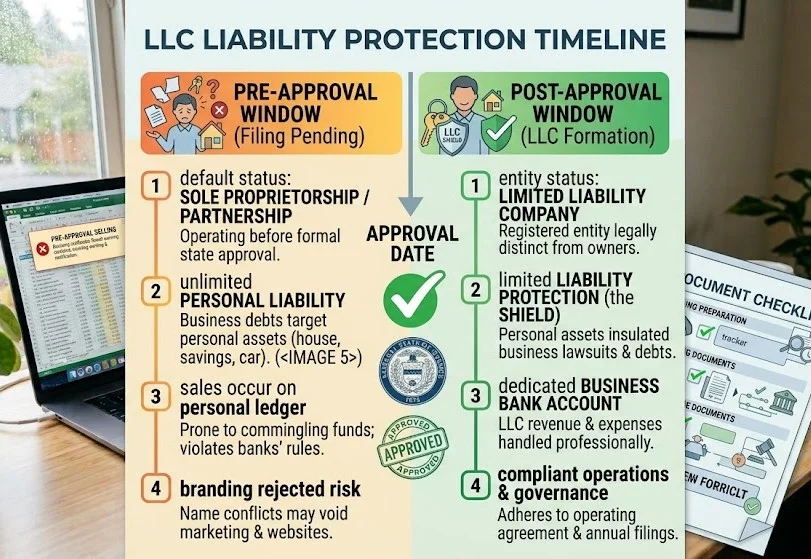
Legal status prior to LLC approval
In the eyes of state courts and the IRS, a business entity doesn't legally exist until the Secretary of State issues a stamped Certificate of Formation. Inc Authority can help you file, but the state's approval timeline determines when your LLC actually exists.
Pre-Approval Window. From the moment you submit your filing until the state approves it, your default legal status is a Sole Proprietorship (if single-owner) or a General Partnership (if multi-owner). Your personal liability is 100% unlimited, and your personal assets, savings, home, car, are all exposed.
Post-Approval Window. Once the Articles are approved and stamped, your LLC legally exists. Your personal liability is shielded, and only the LLC's capital is exposed to business liabilities.
Top 5 operational risks of pre-approval selling
1. Zero Liability Protection. The main reason to form a LLC is keeping your personal stuff separate from business debts. If someone gets hurt or a client sues you before approval goes through, that claim lands on you. They can come after your savings and your house. The hidden risks of sole proprietorship hit you hard in this window.
2. Invalid or Unenforceable Contracts. If you sign a contract using the proposed LLC name before the state formally approves it, that deal might not hold up, or it could be treated as your own personal contract. Under corporate law, signing on behalf of a company that doesn't exist yet can trigger Promoter Liability, which means you, the founder, are personally on the hook for performance and any debt defaults. The Texas Secretary of State puts it this way: "A contract signed on behalf of a business entity that has not yet been formed may bind the individual signer personally."
3. Banking Violations & Commingling Funds. Commercial banks generally won't open a corporate bank account without approved Articles of Organization and an EIN matching the exact corporate name. Pre-approval sales usually get deposited into personal accounts, which creates commingling. Mixing personal and pre-formation business funds early on gives litigators prime evidence to "pierce the corporate veil," and that nullifies your LLC liability shield even after approval.
4. Sales Tax Non-Compliance & Licensing Fines. Most states make you get a Sales Tax Permit before you can collect sales tax. And to get that permit, you need an active legal entity. If you collect sales tax without the right authorization, or under a pending legal name, you're looking at serious state tax audit penalties.
5. Name Rejection Cascades. If the Secretary of State rejects your proposed LLC name during processing, any branding, customer receipts, invoices, or merchant payment configurations set up under that name become legally void and must be rebuilt at significant cost. How to choose a LLC name without trademark issues reduces this risk, but the name must still be approved by the state.
Financial & tax implications comparison
Here's how selling before versus after LLC approval stacks up. The paperwork checklist before filing a LLC includes waiting for approval before you start doing business.
| Risk Dimension | Selling BEFORE LLC Approval | Selling AFTER LLC Approval |
|---|---|---|
| Legal Liability Shield | ❌ None (Full personal exposure) | Active (Personal assets protected) |
| Tax Reporting | Schedule C (Form 1040) / Individual | LLC Disregarded / Partnership / Corporate |
| Merchant Account Status | High risk of frozen processor payouts | Fully verified with corporate EIN |
| Contractual Standing | Personal liability under Promoter rules | Corporate entity bound by agreements |
| Audit Risk Profile | High (Commingling & timing flags) | Low (Clean, separated ledgers) |
Strategic remediation protocol
If sales already happened while your LLC application was still pending, take these steps right now. Your first 30 days after forming a LLC should cover cleaning up any of that pre-approval stuff.
- Pause Unnecessary Transactions: Hold off on signing any new client contracts until we get the state’s written approval.
- Isolate Pre-Formation Accounting: We document every transaction that happened before approval on its own ledger. These count as pre-formation sole proprietor activities for tax purposes.
- Execute a Board / Member Ratification Resolution: Once the LLC is officially approved, we should sign a written resolution that formally ratifies and adopts all the reasonable pre-formation acts, contracts, and expenses the organizers took on.
- Re-Execute Vendor & Client Contracts: For long-term agreements you signed while things were still pending, get an addendum or assignment agreement in place to shift the contractual obligations from you personally over to the new LLC.
Frequently asked questions
Legally yes, but you’d be operating as a sole proprietor with unlimited personal liability. If something goes wrong, your personal assets are on the line. Better to wait for the LLC to clear, or at least set things up carefully with the right paperwork.
They may count as personal contracts, which means you’re on the hook personally. You can sort that out after approval by passing a ratification resolution and signing addendums to move them over to the LLC. But anything you did before approval? That liability’s still yours.
You can ratify the contracts and move the revenue into the LLC once it’s approved, but the liability protection won’t cover anything retroactively. Lawsuits or problems from stuff you did before approval stay on you personally. Keeping things totally separate is always the way to go.