How to choose a LLC name without trademark issues
Contents
Picking a LLC name is fun. But getting the state’s approval doesn’t mean you’re in the clear. The hidden risks of sole proprietorship include liability issues, but trademark infringement is a whole other beast. It can force a full rebrand.
State business registry approval only means no other local company in that state has that exact name. It gives you zero protection from federal or state trademark claims. Pick a name that steps on an existing trademark, and you could get cease-and-desist letters, get forced to rebrand, or face huge legal damages.
State business registration vs. trademark law
To avoid important legal mistakes, you need to understand the distinction between state entity registration and trademark rights. Do you need an operating agreement for your LLC? Yes, but choosing a safe name is just as important for protecting your business long-term.
State Corporate Name Registration is a state-level administrative procedure. If a name is available in your home state, the Secretary of State will register your LLC. But this registration is not a legal defense if a trademark owner sues you for brand confusion.
Trademark Rights are legal protections for words, phrases, or logos that identify where goods or services come from. You can get these rights federally through the USPTO, at the state level, or just by using the mark in the market, which is called "common law" rights. The USPTO puts it this way: "A trademark is a word, phrase, symbol, or design that identifies and distinguishes your goods or services from others. Registration gives you the exclusive right to use the mark nationwide."
Assessing brand strength & distinctiveness
Trademark law sorts business names into a Spectrum of Distinctiveness. The stronger your category, the simpler registration and defense get. The biggest mistake when choosing a LLC service usually comes down to cost, but picking a weak brand name isn’t far behind.
Fanciful Names (Strongest): These are totally made up words, built just to be a brand. Think Kodak, Exxon, Spotify. Risk: You’re unlikely to run into a conflict, and getting registered is pretty easy.
Arbitrary Names (Very Strong): Real dictionary words slapped on stuff that's got nothing to do with them. Think Apple for computers, Shell for gas, Amazon for shopping. Risk? Pretty safe, as long as nobody else in your exact field already grabbed it.
Suggestive Names (Moderate-Strong): These hint at what the product does or its benefit, without spelling it out. Think Netflix for online movies, Greyhound for fast travel, or KitchenAid for appliances. The risk? You get a solid mix of marketing clarity and trademark strength.
Descriptive Names (Weak): Words that just tell you what the business does, where it is, or what it sells. Think "Dallas Fast Plumbing" or "Organic Coffee Roasters." The catch? They’re tough to trademark, nearly impossible to defend, and you’ll constantly run into other companies using similar names.
Generic Names (Unprotectable): Common terms for a category of goods or services, like "The Shoe Store." You can't trademark these, period. The USPTO puts it this way: "Generic terms are words that the public understands as the common name for a product or service. They can never be registered as trademarks."
The step-by-step name vetting process
To make sure your proposed LLC name is safe, run a full 5-phase clearance search before you file any official paperwork. How to keep your LLC compliant starts with picking a legally solid name that won't drag you into court.
Phase 1: State Name Availability Search. Check your home state's Secretary of State online portal to verify that the exact business name (or a confusingly similar one) is available for legal entity formation.
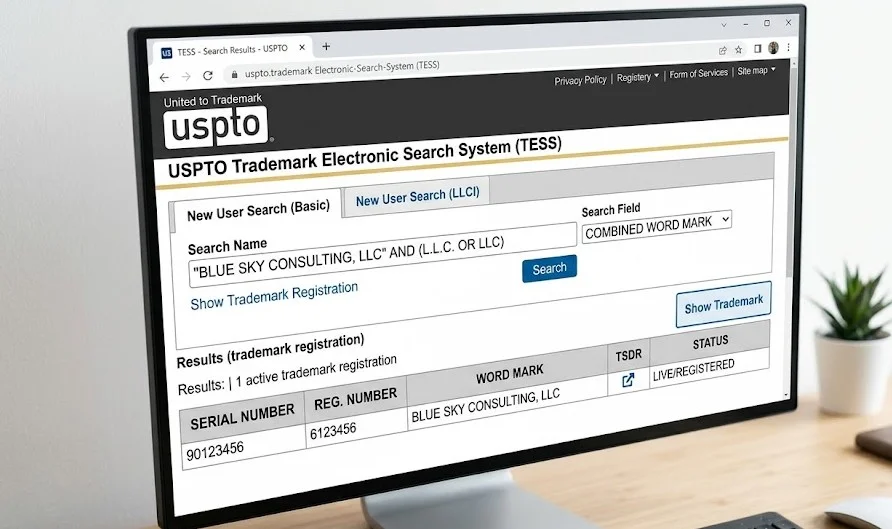
Phase 2: Federal USPTO Trademark Search. We'll search the United States Patent and Trademark Office database using their TESS tool. Look for phonetic matches like "Kool" versus "Cool," alternate spellings, plural versions, and check the right International Classifications, such as Class 035 for Business Services or Class 042 for Software.
Phase 3: Common Law & Regional Usage Search. In the US, common law trademark rights go to whoever uses a mark first in commerce, even without a formal USPTO registration. So, run web searches across a few engines, pairing your proposed name with your industry terms. Also check regional business directories and state DBA databases.
Phase 4: Digital Footprint & Domain Search. We need to make sure your digital real estate is actually open so you don't dilute the brand. Check if the.com,.net, and.co are free, then look at your handles on LinkedIn, Instagram, X/Twitter, and YouTube.
Phase 5: Legal Evaluation (Likelihood of Confusion). Trademark infringement doesn't need two names to be exactly the same. Courts use the Likelihood of Confusion standard, looking at how similar the marks are and how similar the goods or services are. Are these companies playing in the same or related commercial sandbox?
Key legal red flags to avoid
When you’re brainstorming LLC names, steer clear of these risky zones. Inc Authority and other formation services can handle the filing, but they won’t screen your name for trademark problems unless you shell out extra for a search.
Famous Brands & Dilution: Don't ever pick a name that nods to or jokes about big names, like "Starbucks Auto Repair." Those brands get extra legal cover against dilution, even in totally different fields.
Geographic Misdescriptiveness: Avoid geographical references if your business has no actual connection to the area, as state SOS offices and the USPTO frequently reject these.
Restricted Words: Words like "Bank," "Trust," "University," or "Insurance" usually need special board or state approval before you can use them in a LLC name. The New York Department of State notes: "Certain words such as 'bank,' 'trust,' 'insurance,' or 'university' may require prior approval from other state agencies before they can be used in a business name."
Slight Spelling Modifications: Swapping letters, like "Lyft" instead of "Lift" or "Phast" for "Fast," usually won't dodge trademark issues if the names sound the same when you say them out loud.
Summary checklist for securing your LLC name
Use this checklist before you lock in your company name and file the formation paperwork. Comparing Inc Authority vs. ZenBusiness can help you pick a service, but neither one will do your trademark clearance for you.
- Conducted the state Secretary of State name availability check.
- Searched the USPTO Trademark database for exact matches, phonetic equivalents, and related industry classes.
- Conducted a deep web search to find common-law mark holders.
- Verified website domain (.com preferred) and primary social handles.
- Confirmed the name fits in Suggestive, Arbitrary, or Fanciful.
- Optional but recommended: we talked to an IP attorney to get a formal full Trademark Search & Opinion Letter.
Frequently asked questions
No. State availability doesn’t override federal trademark rights. If a company holds a federal trademark, they can still sue you for infringement, even if you’re registered in another state. So always check the USPTO database before you file.
A state business name registration just means no other LLC in that state has that exact name. A trademark, though, gives you legal protection for your brand, your logo, and your name nationwide. It stops others from using anything that could be confused with yours.
Not necessarily. If you’re a local business in one city, common law rights from actual use might do the trick. But if you’re thinking about going national or selling online, a federal trademark’s a solid move to keep your brand safe.