Hidden risks of sole proprietorship, what you need to know
Contents
A sole proprietorship is what you get by default if you run an unincorporated business with just one owner. No setup cost, almost no paperwork, and no state fees. It's the easiest route by far. Check out the five signs your freelancing has outgrown a sole proprietorship before you decide to stick with it.
But that simplicity hides risks that can wreck your finances. Since the law treats you and your business as one, everything you own is on the line.
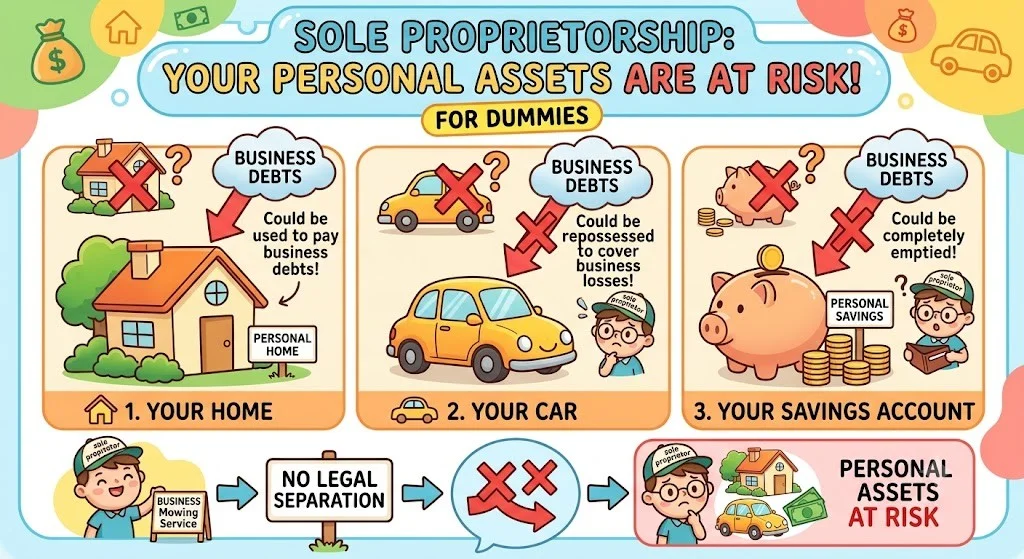
1. Unlimited personal liability
This is the big one. With a sole proprietorship, there's no corporate shield. Your personal stuff, your home, your car, your savings, it's all on the line if your business gets sued or can't pay its debts. Find out why a LLC won't always protect you from lawsuits if you don't follow the rules.
Every contract you sign, every lease you agree to, every vendor debt you take on is personally guaranteed. The U.S. Small Business Administration states: "A sole proprietorship offers no liability protection. You are personally liable for all debts and actions of the business. Your personal assets are at risk."
If you hire employees or subcontractors, you're also on the hook for what they do. One slip up from a staff member could drain your personal savings. That's a lot to carry for anyone running a business.
2. Tax inefficiencies & higher audit rates
Pass-through taxation is simple, but it's also pricey. Sole proprietors pay the full 15.3% self-employment tax on every dollar of net profit. On $100,000 of income, that's $15,300 just for Social Security and Medicare. Read our guide on LLC tax surprises for new owners to see how a LLC with S-corp election can lighten that load.
The IRS notes: "Self-employment tax is Social Security and Medicare tax for people who work for themselves. It works like the taxes most wage earners get taken out of their paychecks."
a LLC with an S-corp election can cut that down by paying yourself a reasonable salary and taking the rest as distributions, so you skip payroll tax on what’s distributed.
There's also the audit angle. Sole proprietors file Schedule C, and the IRS has always audited those at higher rates than corporate returns, mostly because cash income goes unreported and deductions get pushed too far. That's a hidden risk nobody really mentions.
3. Financing & capital constraints
Try raising money as a sole proprietor. You can't sell equity shares. You can't issue stock options. You can't take on investors without restructuring the entire business. Banks view sole proprietors as high-risk borrowers because repayment depends entirely on one person's credit score and health. Check our guide on how much money you need before filing a LLC to see if you're ready to make the leap.
Getting a business loan is tougher. A line of credit? Even tougher. And when you actually get one, the rates sting. That’s a big part of why so many freelancers and consultants bump into a revenue ceiling. They just can’t get the capital to scale up.
4. Dissolution & succession fragility
This one hits hard. A sole proprietorship legally stops existing when the owner dies or gets incapacitated. The business doesn’t carry on. It doesn’t go to family members on its own. It just dissolves. Learn how to avoid administrative dissolution and keep your business alive long-term.
Business bank accounts freeze. Assets fall into probate. Years of work can evaporate because there's no legal entity to step into the owner's shoes. a LLC, by contrast, has perpetual existence. It survives the owner. The California Secretary of State website clarifies: "a LLC is a separate legal entity from its owners. It can continue to exist even if members change or leave."
5. What to do next
If you're spotting these risks and wondering what to do next, forming a LLC is the standard move. It puts a legal wall between you and your business. Your personal assets usually stay safe. Read our full Inc Authority review to see why they're a solid pick for a lot of owners.
We think Inc Authority is a solid choice because they throw in the first year of registered agent service for free. That’s a $100-$300 value you’re getting without paying a cent. ZenBusiness has a free basic plan, but they’ll charge you for the agent. Bizee works the same way, low start, agent costs extra. Northwest bundles the agent in, but their packages start higher. LegalZoom? It’s the most expensive, with service fees stacked on top of state fees.
If you want to see them side by side, our Inc Authority vs. ZenBusiness comparison breaks it all down. And once you're formed, our 30-day checklist for new LLC owners keeps you on track.
Frequently asked questions
Yes. That's the biggest risk. There's no legal separation between you and your business. A lawsuit against your business is a lawsuit against you personally. Your home, car, and savings are all on the line.
The cost varies by state. Filing fees run from $35 up to $500. You'll also need a registered agent each year, which is free if you handle it yourself, or $100 to $300 if you hire a service. And some states tack on annual franchise taxes, like California's $800 minimum.
Probably not if you’re making under $10,000 a year and have no employees. But once you cross that $40,000 to $50,000 mark in annual profit, or you start hiring people, the liability protection starts to pay for itself.