What to do immediately after LLC approval
Contents
Getting your LLC approved is a huge deal. But honestly, it’s just the start. A lot of new owners think they can hit the ground running the second those Articles of Organization land. The top mistakes first-time LLC owners make usually show up within that first week.
Whether you set up your LLC on your own or paid an online service, this guide covers what you need to do once it’s officially approved. The California Secretary of State puts it this way: "After filing, make sure your LLC’s active status checks out and grab any local permits you need before you start doing business."
Verify your LLC has been approved
Before you do anything else, make sure your LLC is officially active. Inc Authority will let you know when your filing gets approved, but you should double check on your own too.
You should have gotten one or more of these: Articles of Organization, Certificate of Organization, Certificate of Formation, or State approval confirmation. States call them different things, but they all do the same job.
Visit your Secretary of State’s business search site and check that your LLC shows up as Active, Good Standing, or Existing. Don’t just trust an email confirmation. The Texas Secretary of State says: “You can verify the status of your LLC through the Secretary of State’s online business search tool.”
Download and store every document
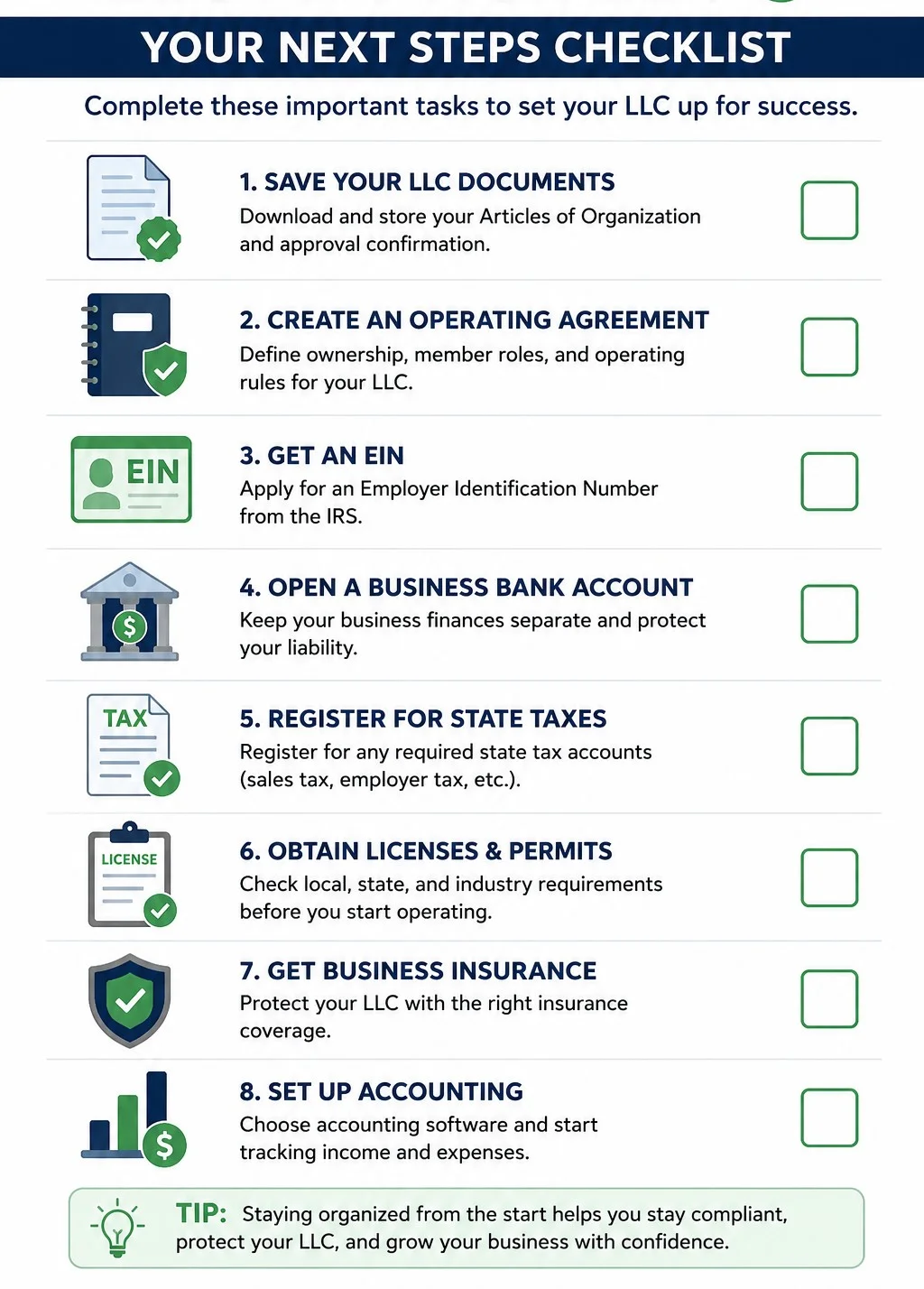
Create both digital and physical copies of every important document. The paperwork checklist before filing a LLC helps you prep, but storing those documents after approval matters just as much.
This includes your Articles of Organization, approval certificate, filing receipt, payment confirmation, registered agent info, and all state correspondence. Keep digital copies in cloud storage and stash printed ones somewhere safe. Lots of banks and lenders might ask for these down the road.
Create an operating agreement
An Operating Agreement lays out how your LLC runs. Your state might not demand one, but every LLC should still have it. Do you need an operating agreement for your LLC? Yeah, even if you’re the only member.
It covers ownership percentages, member responsibilities, voting rights, profit distributions, how to add or remove members, and what happens if you dissolve the business. Single-member LLCs get a lot out of it too. An Operating Agreement helps prove your business is separate from you personally, which makes your liability protection stronger. The New York Department of State puts it this way: "While an operating agreement is not required to be filed, it is highly recommended for all LLCs."
Get an employer identification number (ein)
Most LLCs need to get an EIN from the IRS. Think of it as the Social Security Number for your business. What is an EIN and why do you need it? You'll need it for banking, hiring, and taxes.
You’ll usually need one to open a business bank account, hire employees, file federal taxes, apply for business credit, and work with many vendors. Even if you’re a single-member LLC without employees, getting an EIN is usually a smart move because it lets you avoid giving your personal Social Security Number to clients. The IRS states: "You can apply for an EIN online at IRS.gov. This service is free."
Open a business bank account
This is a big one after you get your LLC approved. Don’t ever mix personal and business cash. How to open a business bank account after forming a LLC is key to keeping your liability protection intact.
A dedicated business checking account keeps your liability protection intact, makes bookkeeping way easier, simplifies tax prep, helps you build business credit, and just looks more professional. Banks usually ask for your EIN, Articles of Organization, Operating Agreement, and a photo ID.
Register for State Taxes. Depending on your business and state, you might need to set up sales tax, employer taxes, franchise taxes, excise taxes, or state income tax accounts. The rules differ a lot. A consultant might just need federal tax registration, but a retail shop could also need a sales tax permit before it starts selling anything.
We need to talk about business licenses. a LLC approval doesn't mean you're free to start operating. You might still need city or county licenses, professional ones, health permits, building permits, even home occupation permits. Lots of businesses end up needing licenses at several government levels.
Learn what you need to file each year. Every LLC has ongoing stuff to handle, like annual reports, biennial reports, franchise tax payments, keeping a registered agent, and state renewal fees. Miss a deadline and you could face late fees, administrative dissolution, or lose your good standing. So set reminders now.
We get it, you might think a LLC covers everything. It doesn’t. You still need insurance. General Liability handles stuff like a customer tripping in your office or a bad ad. If you’re a consultant, accountant, or designer, Professional Liability is your friend. And once you hire people, Workers’ Comp is almost always a must.
Set Up Bookkeeping. Don’t wait until tax season. Pick your accounting software early and track income, expenses, mileage, receipts, equipment buys, owner contributions, and owner distributions. Good bookkeeping saves you a ton of time down the road.
Separate Business and Personal Expenses. New LLC owners often mess this up by paying business costs from personal accounts. Don’t. Use your business debit card, pay yourself the right way, and keep every receipt. Mixing purchases is a huge risk. Courts can pierce the corporate veil if you don’t treat the LLC like its own thing.
Build Business Credit. Start early. It takes time to develop. You’ll need an EIN, business bank accounts, and vendor credit used responsibly. Then apply for business cards and pay every bill on time. Good credit opens up better financing options down the road.
Create Your Business Identity. Your LLC is approved. Now it's time to show up publicly. Grab a domain name, a professional email, a phone number, a Google Business Profile, and your social handles. Keep them consistent everywhere, and people will trust you.
Create Basic Legal Documents. Every business needs standard docs like client contracts, service agreements, Privacy Policy, Website Terms of Use, Refund Policy, independent contractor agreements, and NDAs. Written contracts cut down on mix ups.
If Hiring Employees. Before you bring anyone on, grab an EIN, sign up for payroll taxes, verify they can work legally, get workers' comp if you're looking for it, and set up payroll software. The rules kick in the second you hire.
Protect Important Records. Make one folder for tax returns, bank statements, receipts, contracts, licenses, insurance policies, and meeting notes if you've got a multi-member LLC. Good records make audits and tax filings way easier.
Understand BOI Reporting. Lots of LLCs have to file Beneficial Ownership Information reports under federal law, but the rules have shifted a bunch thanks to court rulings. So check what's current before you assume you're on the hook or off the hook. If you're required and don't comply, the penalties can really sting.
Consider S Corporation Tax Election. a LLC is a legal structure. An S Corporation is a tax election. Some LLC owners eventually elect S Corp taxation to cut self-employment taxes. That usually only makes sense once your business hits a certain profit level, since it adds payroll and compliance work. Talk to a CPA before you do it.
Frequently asked questions
In most states, yes. But depending on your industry and where you’re located, you might also need business licenses, permits, or tax registrations before you can legally operate. And don’t forget to check with your city and county too.
Many single member LLCs can legally use the owner's Social Security number for some tax stuff, but getting an EIN is usually the smarter move. It keeps your personal info safer, and you'll often need it just to open a business bank account.
Some states require one, but plenty don’t. Even when it's optional, an Operating Agreement is still a smart move. It lays out how the LLC runs and helps keep the business separate from the owners.