How to keep your LLC compliant
Contents
Forming a LLC is step one. Keeping it compliant is where the real work begins. To preserve the corporate veil that protects your personal assets, you need to maintain continuous compliance with state, federal, and local requirements. The hidden risks of sole proprietorship include personal liability, and a LLC that fails to stay compliant can lose that protection just as quickly.
Not staying compliant can hit your wallet with fines, lose your Good Standing, get your LLC administratively dissolved, and even put your personal assets on the line for business debts. The California Secretary of State puts it this way: "a LLC that fails to file its Statement of Information or pay required fees may be suspended or dissolved by the Franchise Tax Board."
Internal compliance requirements (corporate governance)
Internal compliance is how you run your company and keep records on the inside. LLCs don’t have as many legal formalities as corporations, but you still need to follow governance rules to show your business is its own legal thing. Do you need an operating agreement for your LLC? Yeah, it’s the core document that proves your LLC is a real business, not just a hobby.
1. Maintain and Update the Operating Agreement. The Operating Agreement is the core legal contract for your LLC. It lays out who owns what, how the business runs, how profits get split, and how decisions get made. Even if you’re a single member, you need one in writing to show your LLC is its own legal entity, not just a solo operation. With multiple members, it’s key for spelling out ownership stakes, voting power, and what happens if someone wants out. If management shifts or ownership percentages change, you’ve got to draft and sign formal amendments. No shortcuts there.
2. Strict Separation of Personal and Business Finances. Mixing personal and company money is the number one reason courts pierce the corporate veil. Every dollar the business brings in has to go into a dedicated LLC checking account, and every business expense gets paid from that account or a LLC credit card. Don’t ever pay personal bills from the LLC account. The IRS says: "Mixing personal and business funds can put your LLC's liability protection at risk."
3. Document Major Business Decisions. Most states don't legally require annual member meetings for LLCs, but writing down major decisions gives you a paper trail that shows you're running things responsibly. So draft written resolutions for stuff like opening bank accounts, taking out loans, buying capital assets, bringing on new members, or switching your tax classification. How to avoid administrative dissolution usually comes down to keeping these records, since they prove you're a legit operation.
4. Maintain a Central Corporate Binder or Digital File. Your LLC needs one organized spot for all its main paperwork. Keep your stamped Articles of Organization, the IRS EIN confirmation letter, your current Operating Agreement and any amendments, member ledgers, meeting minutes, past tax returns, and active business licenses together.
External state & federal compliance requirements
External compliance means handling the filings, disclosures, and tax upkeep that government agencies require. Annual reports explained digs deeper into the most common one.
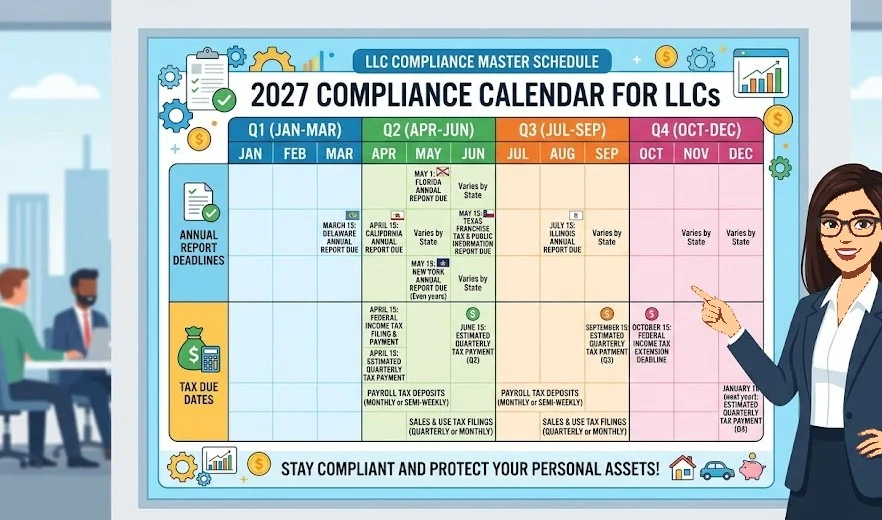
1. Annual or Biennial Reports. Most states want LLCs to file these on a regular basis so public records stay accurate. They basically confirm your main address, where you get mail, who your registered agent is, and the names of your managers or members. Some states make you do it every year on your formation anniversary, others pick a set date on the calendar, and a few stretch it to every two years. Miss one and you’re looking at late fees, a delinquency status, and eventually the state can just dissolve your LLC.
2. State Franchise Taxes & Minimum Privilege Taxes. A franchise tax is what many states charge you just for the right to exist and do business, even if you don't make a dime. Some states hit you with a flat rate no matter your revenue, like California's $800 minimum or Delaware's $300. Others figure it out based on what you actually bring in. So even if your LLC earned zero this year, you still owe that mandatory minimum. The California Franchise Tax Board puts it plainly: "Every LLC doing business in California must pay the annual minimum franchise tax of $800."
3. Maintain an Active Registered Agent. Every state requires LLCs to pick a Registered Agent with a physical street address in the state where you register. That agent grabs your Service of Process, so lawsuit notices, plus official government mail, during normal business hours. If your agent moves, quits, or switches services, you've got to file a formal Change of Registered Agent form with the state right away. Let that lapse and you're looking at default legal judgments and fast administrative dissolution. Inc Authority throws in the first year of registered agent service for free, which is a solid deal. ZenBusiness and Bizee tack on extra fees for the agent. Northwest bundles it in but starts at a higher price. LegalZoom ends up costing you the most overall.
4. Beneficial Ownership Information (BOI) Reporting. Under the federal Corporate Transparency Act, most LLCs created or registered in the U.S. have to submit Beneficial Ownership Information reports to FinCEN. Newly created entities must file within statutory windows after formation approval. And if anything changes with your company info or beneficial owner details, you’ve got 30 days to file an updated BOI report.
Tax compliance & financial filing obligations
By default, the IRS treats LLCs as pass-through entities. A single-member LLC files Schedule C with Form 1040 and pays income tax plus 15.3% self-employment tax on all profits. Multi-member LLCs file Form 1065 and hand out Schedule K-1s to members. LLC tax surprises for new owners can really trip you up if you're not ready for estimated quarterly payments and that self-employment tax.
LLCs can also pick a different tax setup. If you go S-Corp, you’ve got to file IRS Form 2553 and run real W-2 payroll for officer-owners, paying yourself a "reasonable salary." Or you could choose C-Corp status by filing Form 8832, which means a flat 21% corporate tax rate, but you might get hit with double taxation on dividends.
Estimated Quarterly Tax Payments. Taxes aren’t automatically withheld from pass-through LLC profits, so members have to make estimated quarterly federal and state payments if they think they’ll owe $1,000 or more for the year. The due dates are April 15, June 15, September 15, and January 15.
State and Local Tax Compliance. If you're selling physical goods or taxable services, you have to get a Seller's Permit or Sales Tax License, collect tax from buyers, and send those funds in every month or quarter. Hiring employees? Then you'll need to register for state unemployment insurance, set up state income tax withholding, and file quarterly Form 941s.
Business licenses, permits & local registrations
State LLC registration lets you exist as an entity, but it’s not an operational permit. You still need to keep local permits current. How to choose a LLC name without trademark issues matters, but so does staying on top of your local business licenses.
Most cities or counties make you pull an annual local tax receipt or business license just to operate inside their limits. Health department clearances for food spots, environmental permits, occupational licenses for pros, and home occupation permits for remote folks, those can all pop up. If your LLC does real business in states beyond where you formed it, you have to file for Foreign Qualification in each of those places. And if you run under a trade name that isn't your legal LLC name, watch your local DBAs, since they usually need renewing every 3 to 5 years.
Event-driven compliance filings
When your business goes through structural changes, you’ve got to formally tell government bodies by sending in event-driven filings. Comparing Inc Authority vs. ZenBusiness can help you pick a formation service, but neither one will file your amendments or dissolution paperwork for you after the initial setup.
Articles of Amendment. You’ll file an Articles of Amendment with your Secretary of State if you change the LLC’s legal name, tweak the management setup, move the registered business address, or shift the core purpose you laid out when you first formed the company.
Reinstatement or Voluntary Dissolution. If your LLC falls out of Good Standing because you missed reports or didn't pay taxes, you've got to cover all the back fees, file those delinquent returns, and send in a Reinstatement Application to get your protection back. Now, if you're shutting the business down, you'll file formal Articles of Dissolution, settle any debts, cancel your licenses, and turn in final tax returns. That way you won't rack up more state penalties.
Frequently asked questions
Your LLC will probably lose Good Standing with the state. That means late fees, and if you miss the grace period (usually 30 to 90 days), the state might dissolve your business on its own. You can reinstate it, but that costs more in back fees and penalties.
Yes. Even with zero revenue, you still have to file a federal tax return (Form 1065 for multi-member LLCs or Schedule C for single-member LLCs). You might also owe minimum franchise taxes in states like California, even if you're not profitable.
Yes, if you’ve got a real street address in the state and can be around during normal business hours to accept legal paperwork. But if you’re on the road a lot or just want to keep your info private, going with a professional registered agent service is the smarter move. Inc Authority throws in the first year free.