LLC vs corporation tax differences
Summary: LLCs pass profits straight through to you. Corporations get taxed twice on the same money. But with a LLC, you’re on the hook for self-employment tax on everything you earn, whereas S-corp owners can dodge some of that. So what’s right for you? It really comes down to your income, how many folks are in on it, and where you see things going.
Contents
The tax difference between a LLC and a corporation isn’t just about rates. It’s about how money moves through the business. One gets taxed once. The other gets taxed twice. And there’s a third option that lets you have it both ways.
Here's the short version: LLCs are pass-through entities. All profits flow to your personal tax return, and you pay tax once. C-corps pay tax on profits, and then shareholders pay tax again when they get dividends. Double taxation is the killer. But there's detail (there's always detail).
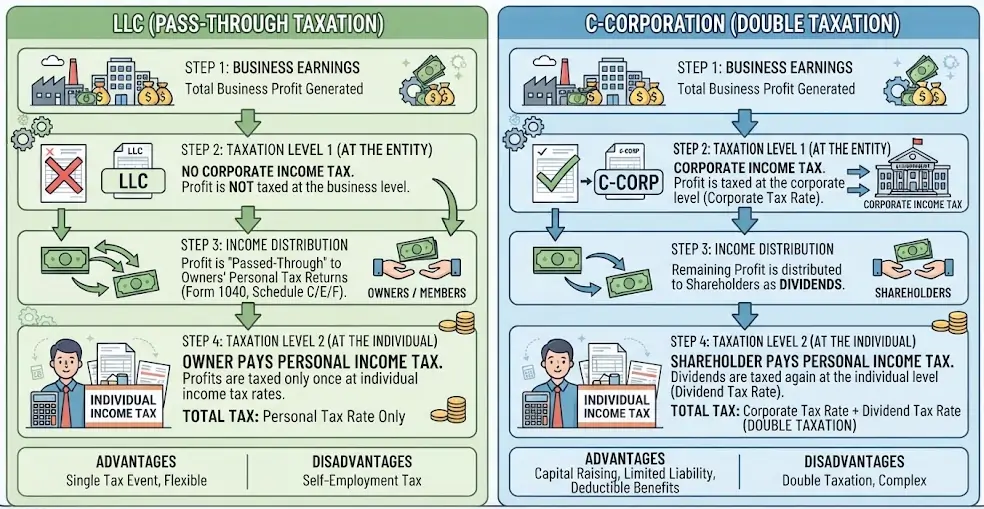
Tax overview
The IRS doesn't tax "business entities." It taxes the people who own them. So the real question is, where does the tax get paid? That's where LLCs and corporations split ways, big time.
| Entity Type | Tax Structure | Tax Rate | Self-Employment Tax |
|---|---|---|---|
| Single-Member LLC | Pass-through (Schedule C) | Individual income tax rates (10-37%) | 15.3% on all profits |
| Multi-Member LLC | Pass-through (Partnership) | Individual income tax rates (10-37%) | 15.3% on all profits |
| LLC with S-Corp Election | Pass-through (S-corp) | Individual income tax rates (10-37%) | 15.3% only on salary, not distributions |
| C-Corporation | Double taxation | Corporate rate: 21% + individual rate on dividends | None (not subject to SE tax) |
State taxes really complicate things. Forming a LLC in California hits you with a $800 yearly franchise tax, and that's on top of federal taxes. Texas LLCs owe franchise tax as well. Delaware keeps taxes lower, but filing costs more. So the state you pick matters nearly as much as the entity type.
How llcs are taxed
By default, the IRS sees a LLC as a pass through entity. So the LLC itself doesn’t pay federal income tax. Instead, the profits or losses go straight to the owners’ personal returns. You pay tax at your own rate, which falls between 10% and 37%, based on what you make overall.
Single-member LLCs file a Schedule C with their personal 1040. It’s pretty simple. You report income, deduct expenses, pay self-employment tax (15.3%), and that’s it. What an EIN is and why you need it comes into play here because that’s what you’ll use to file.
Multi-member LLCs file Form 1065 (Partnership Return) and issue K-1s to each member. Each member reports their share of profits on their personal return. The partnership itself doesn't pay tax, but it does have to file.
One big advantage: LLCs can hand out cash without extra tax. You're already taxed on the profits, so you can take distributions with zero tax. That’s massive. Unlike corporations, where dividends get hit again.
How corporations are taxed
C-corporations are their own tax paying entities. They file Form 1120 and pay tax at the corporate rate, which is a flat 21% right now. Then, when dividends go out to shareholders, those folks pay tax on them at their own individual rates, which can go up to 20%.
That’s the double-taxation problem. The same dollar of profit gets taxed twice: once at the corporate level, once at the shareholder level. Total tax can easily exceed 40% on distributed profits.
There are workarounds. Corporations can just hold onto earnings instead of paying them out. But shareholders usually want those payouts. And the IRS has rules to stop companies from dodging dividend taxes forever, like the accumulated earnings tax.
One advantage of C-corps: they don't pay self-employment tax. Shareholders who work there still pay payroll taxes, but the business itself skips that 15.3% hit LLCs take. At higher incomes, that gap really adds up.
Also, C-corps can offer certain benefits that LLCs can't, like qualified small business stock (QSBS) exclusion, which can wipe out capital gains taxes on the sale of the business. That's a niche benefit but worth knowing if you plan to sell.
Pass-through vs double taxation
This is the heart of the difference. With a LLC, you pay tax once. With a C-corp, you pay tax twice. Here's how it plays out:
LLC example: Your LLC makes $100,000. You pay tax on that $100,000 at your individual rate (say 24%). You also pay 15.3% self-employment tax on the full amount. Total federal tax: roughly 39.3%. You take the remaining $60,700 home. No additional tax when you distribute.
C-corp example: Your C-corp makes $100,000. The corporation pays 21%, so that’s $21,000. The rest, $79,000, goes out as dividends. You pay 15% on those dividends, which is $11,850. Add it up: $32,850 in total tax. You keep $67,150. So you’re looking at roughly 33% all in.
Wait. The C-corp wins here? That’s odd. But the C-corp math skips self-employment tax on that $79,000 distribution. The LLC hits you with 15.3% on the whole $100,000. So at some income levels, the C-corp can actually save you more on taxes.
LLC tax surprises for new owners usually boil down to one thing. That self-employment tax stings way more than folks think.
Self-employment tax
This is the kicker. LLC owners pay 15.3% self-employment tax on all profits. That’s the combined Medicare and Social Security tax. W-2 employees pay 7.65% (their employer pays the other half). LLC owners pay the full 15.3% themselves.
At $100,000 of profit, that’s $15,300 just for self-employment tax. And that’s before your regular income tax. Yeah, that’s steep.
There’s a cap on Social Security tax, $168,600 in 2024. Past that, you still owe Medicare, 2.9% plus an extra 0.9% if you earn a lot. But the self-employment tax doesn’t vanish entirely.
C-corporations skip self-employment tax. Owners who work for the company pay payroll taxes on their salary, though. Distributions from the corporation don't get hit with payroll tax. That's where the savings come from. The difference between LLC members and managers changes who owes this tax, but the core setup stays the same.
S-corp election for llcs
This is where it gets interesting. a LLC can elect to be taxed as an S-corp. You’re still a LLC legally, but for tax purposes, you’re treated like one. And S-corps have a big edge: they skip self-employment tax on distributions.
Here’s how it works: you pay yourself a “reasonable salary.” You pay payroll taxes on that. Then you take the rest of the profits as distributions. Those aren’t hit with self-employment tax. So you save 15.3% on whatever you take as distributions.
The catch: the salary has to be reasonable. Pay yourself $10,000 and pull $90,000 as distributions, and the IRS will reclassify part of that as salary. There’s case law on it. You can’t game the system.
But for businesses pulling in $80,000+ in profit, the math usually works out. You save more on self-employment tax than you spend on extra filing fees. Comparing Inc Authority vs ZenBusiness can help you figure out which services actually support S-corp election filing, since not all of them handle that part well.
One warning: S-corps require payroll. You need to run it, file Form 941, and handle the tax deposits. That’s extra paperwork, and you’ll likely need a payroll service. But the tax savings usually make it worth the trouble.
Which entity saves you more money
Here's the rule of thumb:
Choose a LLC (default pass-through) if:
- Your business profits are under $50,000.
- You want tax filing to be simple.
- You're a solo founder who doesn't want payroll.
- You plan to reinvest most profits.
Pick a LLC that’s elected S-corp status if:
- Your business profits are between $50,000 and $200,000.
- You want to save on self-employment tax.
- You're willing to run payroll.
- You have a salary number that actually makes sense.
Choose a C-corporation if:
- You plan to raise venture capital.
- You want to offer stock options to employees
- Your profits are high and you want to hold onto those earnings.
- You're willing to accept double taxation for growth advantages.
Most founders should default to a LLC. You can always elect S-corp status later. You can’t undo C-corp status easily, and it’s expensive and complicated. So the conservative move is to start as a LLC, then decide if S-corp makes sense.
Whether LLC services are actually worth paying for is a separate question, but many formation services can handle S-corp election if you decide to go that route. Just don't pick a service that can't.
Also worth noting: state taxes vary a lot. New York LLCs pay more than Wyoming LLCs. Your state choice can tip the numbers either way. So think about state tax rates when you decide.
Frequently asked questions
It depends. LLCs hit you with self-employment tax, 15.3% on every dollar of profit. C-corps don’t pay that. But then C-corps get taxed twice on dividends. So for smaller profits, a LLC usually comes out ahead. For bigger money, a C-corp or S-corp could actually save you some cash.
The main advantage is pass-through taxation. LLC profits get taxed once, on your personal return. Corporate profits? Taxed twice. Once at the corporate level, and again when they’re handed out to shareholders.
Yes. a LLC can pick S-corp or C-corp tax status by filing Form 2553 or Form 8832 with the IRS. That’s just a tax move, though. The legal setup stays a LLC.
a LLC is the legal structure. An S-corp is a tax election. a LLC that elects S-corp status skips self-employment tax on distributions. A default LLC pays that tax on all profits. Legal liability protection? Same.
Typically you’re looking at $50,000 to $80,000 in profit. Below that, the payroll and filing costs just eat up the tax savings. Once you go past that, the self-employment tax savings usually make the extra hassle worth it.