The anatomy of a budget illusion, what your first year as a LLC actually costs
Contents
When founders budget for their first year, they usually get hooked by a tidy little math trick. They check their state’s filing fee, like $50 in Colorado or $125 in Florida, toss in a small charge for an online service, and figure their runway’s solid. But that number’s a mirage.
Then reality hits.
By month three, founders are bleeding cash through structural side effects, hidden statutory requirements, and administrative friction points that standard business guides totally ignore.
If you want the real number for what a LLC costs in year one, you’ve got to go beyond that first state receipt. The hidden expenses add up fast. For a fuller view of what ownership actually costs after that, our annual costs of owning a LLC piece breaks down the ongoing picture.
1. The "geographic mismatch" penalty ($100 - $1,500+)
One of the priciest surprises in year one? Incorporating somewhere like Wyoming or New Mexico for privacy or cheap filing fees, then finding out you don’t actually get to pay there.
The Foreign Qualification Trap: If you live, work, or store inventory in a state different from where you legally formed your LLC, you’re legally on the hook to register as a “Foreign LLC” in your home state.
The Double-Billing Reality: In your very first year, you end up paying formation fees, registered agent costs, and compliance reports in two separate states at the same time. What started as a cheap $50 out-of-state setup instantly turns into a multi-hundred-dollar cross-border compliance mess. Our home state vs Wyoming LLC comparison explains exactly how this trap works.
2. The local municipal paperwork toll ($50 - $500+)
Most online guides only talk about state filings. They act like once the Secretary of State says yes, your business just exists. It doesn’t.
The County and City Grab: Almost every municipality wants local operational permissions. Depending on your industry and where you're at, your first year will likely need a general local business license, a home-occupation permit if you work from a residence, or industry-specific health and safety permits.
The Staggered Timeline: These aren't bundled into your state filing fee. They need separate applications, their own fees, and local renewals that keep coming back. That catches new founders totally off guard, right when cash flow's tightest.
For an Analysis of what permits you might need, our LLC paperwork checklist before filing article covers the full scope of required documents.
3. The "silent upcharge" on business infrastructure ($200 - $600)
a LLC can’t safely or legally run off your personal digital footprint without risking your corporate veil. But treat it like a real entity, and you’re suddenly stuck paying for software subscriptions you didn’t ask for.
The Privacy Tax: If you won’t put your home address on public state databases, you’ve got to pay for a commercial registered agent or a virtual business address service.
The Banking Overhead: Sure, "free" business checking accounts are out there, but a lot of traditional banks hit you with minimum balance fees or opening deposit requirements. That ties up your cash right when you need it most to grow.
Services like Inc Authority throw in a free registered agent for your first year with their formation package, which saves you that initial $100 to $150. But watch out, renewal pricing jumps a lot in year two. ZenBusiness does the same kind of thing. Northwest Registered Agent keeps pricing more transparent but costs more upfront. Our Inc Authority vs Northwest Registered Agent comparison gets into those pricing differences.
The first-year cost matrix, what founders actually spend
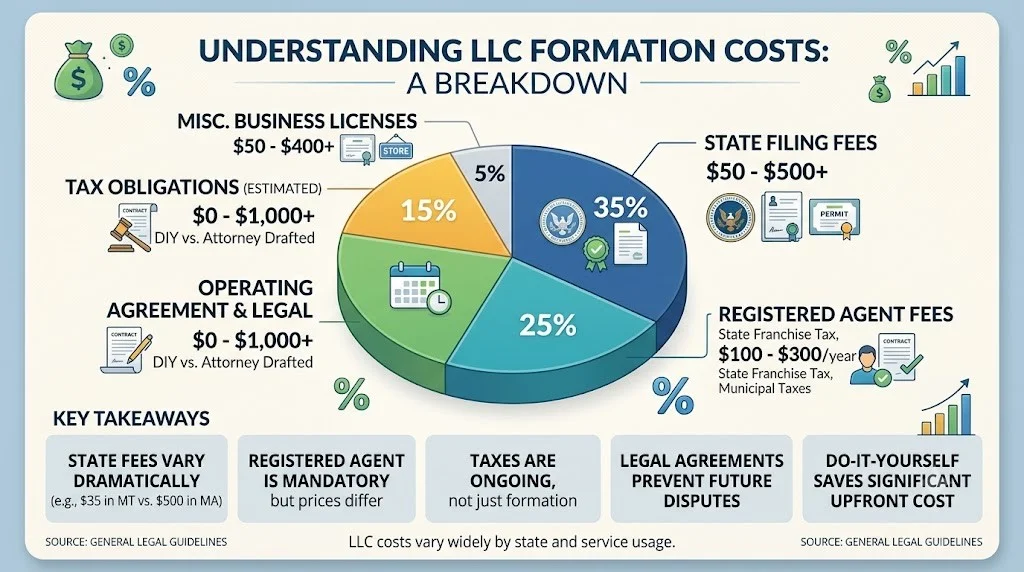
To see the stark contrast between the theoretical cost and the lived financial reality of year one, consider this breakdown:
| Expense Layer | The "Mythical" First-Year Budget | The "Prudent & Real" First-Year Budget |
|---|---|---|
| State Formation Filing | $50 – $100 | $50 – $500 (plus potential franchise taxes like California's $800) |
| Registered Agent / Privacy | $0 (Self-managed) | $100 – $300 (To keep your home address off public records) |
| Legal & Governance Structure | $0 (Free generic template) | $0 to $500+ (Custom operating agreement or legal review) |
| Local Licenses & Permits | $0 (Ignored) | $50 – $400 (City/county operating licenses) |
| Federal / Regulatory Filings | $0 (DIY BOI report) | $0 to $100 (If using a secure filing service) |
| Total First-Year Outlay | ~$50 to $100 | ~$500 to $2,000+ |
The creative takeaway: a LLC doesn’t cost $50 to run in its first year. It costs whatever it takes to legally isolate your personal life from your business operations. So budget for the friction, plan for local municipal fees, and don’t fall for the trap of only staring at the state’s initial filing price tag.
If you're trying to keep first-year costs down, our best free LLC service guide can help you find cheap formation options that don't skimp on quality. And once you're past year one, our first 30 days after forming a LLC piece walks you through the key early moves.
The $50 filing fee? That’s a trap. It pulls you in, but actually running a proper LLC in year one? That’ll run you $500 to $2,000 at least. You’ve got the geographic mismatch, local licenses, and infrastructure costs to budget for. Skip that, and your LLC is dead on arrival.
Frequently asked questions
States like Colorado ($50), Arizona ($50), and New Mexico ($50) have some of the lowest filing fees. But don't forget the ongoing stuff, like annual reports and franchise taxes.
If you want to keep your home address off public records, yes. Acting as your own registered agent is free, but it costs you your privacy and opens the door to spam and process servers.
The Beneficial Ownership Information (BOI) report is a federal filing you’ve got to do under the Corporate Transparency Act. Nearly every new LLC has to file it within 90 days of forming. Miss it, and the penalties are harsh.
Budget at least $500 to $2,000 for your first year. That covers state fees, a registered agent, local licenses, and the basics you'll need to get going. The exact figure really depends on your state and what industry you're in.