What nobody tells you about the true annual costs of a LLC
Contents
When you’re thinking about starting a business, it’s easy to fixate on the launch costs. The one time filing fee, a cheap registered agent, maybe a logo. You clear those hurdles and breathe easy, figuring the ongoing expenses will drop to almost nothing.
This is a dangerous miscalculation.
a LLC isn’t some static document you file and forget. It’s a living financial entity, and keeping it alive costs money every single year. Most people only look at the renewal fee, but that misses the real picture. You’ve got to dig into the Total Cost of Ownership, the stuff that blindsides owners who didn’t plan ahead. If you want a sense of what year one actually hits you for, our how much does a LLC really cost first year piece breaks down that initial outlay.
1. The geographic tax trap, the multi-state and franchise penalty
The most profound hidden expense of owning a LLC? It’s that where you live can totally skew your yearly costs, no matter what your business actually brings in.
The Franchise Tax Reality: Many states charge an annual franchise tax or privilege tax just for the right to exist as a LLC, regardless of whether your business generated a single dollar of revenue.
The California Outlier: For example, run a LLC in California and you’re hit with a mandatory $800 annual franchise tax. That turns what seems like a cheap setup into a hefty, recurring bill. Other states, like Delaware at $300 a year or Tennessee at $300 plus, punish you just the same whether you’re idle or thriving.
The Foreign Qualification Multiplier: If you form your LLC in a privacy-friendly state like Wyoming or New Mexico but physically operate out of New York or California, you are legally required to register as a "Foreign LLC" in your home state. This means you are paying double annual fees, maintaining compliance and state reports in both jurisdictions simultaneously. Our home state vs Wyoming LLC comparison explains why this trap catches so many founders.
2. The operational toll, bookkeeping and complex tax prep
Standard personal tax returns? Pretty simple. But the second you add a LLC, your accounting needs jump overnight, and that’s hundreds or thousands of dollars tacked onto your yearly baseline.
The Pass-Through Premium: Even a single-member LLC treated as a disregarded entity needs clean, separate books to keep the corporate veil intact. Hand a CPA a mess of mixed personal and business bank transactions at year-end, and you'll get a hefty cleanup bill.
The Multi-Member S-Corp Pivot: If your LLC elects to be taxed as an S-Corp to save on self-employment taxes, you’ve moved up a notch. That means you now need corporate tax returns (Form 1120-S) and a real payroll setup, so your yearly accounting bill climbs a lot.
For a deeper look at the tax implications of different structures, our LLC tax surprises for new owners article covers what to expect.
3. The compliance creep, silent price hikes on infrastructure
Maintaining your corporate "Good Standing" means you’re locked into a permanent lineup of recurring software and service subscriptions. And those add up fast.
Commercial Registered Agent Renewal: That $49 promo rate for year one often jumps to $150–$300 a year after that. It’s one of the biggest surprises we see in our registered agent pricing comparison research.
Mandatory Business Licenses: Local municipalities and counties often ask for yearly or every other year occupational licenses, zoning permits, or industry specific renewals. These quietly eat away at your money long after you open.
The Platform Upsell: Lots of LLC services lure you in with a low first year registered agent fee, then the price climbs later. Inc Authority throws in a free year with their formation package, but you'll feel it at renewal. ZenBusiness does the same sort of thing. Northwest Registered Agent keeps pricing clearer, though you pay more from the start. Our Inc Authority vs Northwest Registered Agent comparison breaks down those cost gaps.
The annual cost matrix, what to budget for year two and beyond
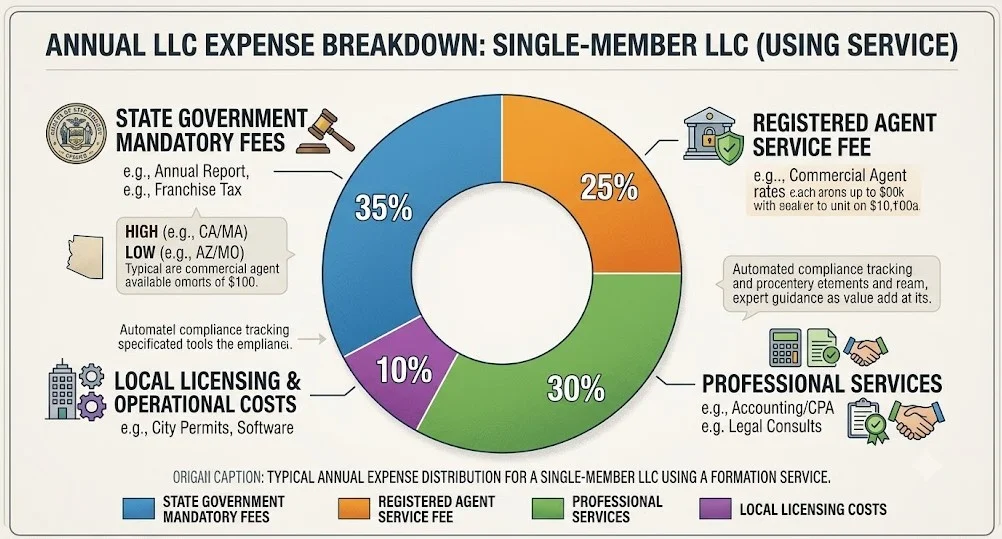
To keep your liability shield active and your business out of administrative dissolution, your recurring annual baseline typically spans a wide range depending on state complexity.
| Expense Category | Typical Annual Range |
|---|---|
| State Annual Reports / Periodic Fees | $0 to $800+ (e.g., California Franchise Tax) |
| Commercial Registered Agent Service | $50 to $300 |
| CPA Tax Preparation & Filing | $300 to $1,500+ |
| Local Business Licenses & Permits | $50 to $500+ |
| Total Real Annual Cost of Ownership | $400 to $3,000+ per year |
The creative takeaway: a LLC is an ongoing subscription to corporate protection, not an one time purchase. When you build your financial projections, look past the initial setup fees and bake these cumulative annual realities into your business model from day one.
If you're trying to keep these costs in check, our best value LLC service guide can help you find providers with clear, steady pricing. No nasty renewal surprises.
a LLC isn't an one time expense, it's an annual subscription to corporate protection. The $50 to $100 filing fee is just the down payment. The real cost is the $400 to $3,000 or more you'll pay every year to keep your liability shield intact. Build that into your business model from day one.
Frequently asked questions
For most founders, the annual franchise tax in states like California ($800) or Delaware ($300) is the biggest single recurring cost. For others, CPA fees for tax prep can run over $1,000 a year.
No. If you want to keep your liability protection and stay in good standing, you’ve got to pay the state fees and file your reports. Some states charge less, like Ohio, which has no annual report fee. But most will hit you with recurring costs.
Most states make you file a report every year or every other year. A few, like Ohio and Arizona, don't charge a fee for it. But they might hit you with other taxes or rules instead.
Choose a state with lower fees if you're location-independent. Use a registered agent whose renewal pricing is clear. Do your own bookkeeping if you can. And don't form LLCs in multiple states unless you really have to.