Can you switch registered agents? yes, here's how
Contents
Yes, you can switch registered agents for your LLC or corporation. Most of the time it’s pretty simple. You file a form, pay a small fee, and you’re done. But here’s the thing: every state does it a little differently, and if you mess it up, your business could face some real problems.
Your registered agent is your legal lifeline. They’re the person or service that handles official state mail, tax notices, and service of process, like lawsuits, on your behalf. Under U.S. corporate law, every active business has to keep a designated Registered Agent in each state where it operates [citation:1][citation:6]. If you mess up the change, you might miss a lawsuit notice or blow off a state filing.
Here's the good news. Switching is common, and services like Inc Authority and Northwest are built to handle this for you. But you can also do it yourself. We'll walk you through the whole process.
Why switch your registered agent?
You might want to switch for a few reasons, but privacy is the big one. If you’re your own registered agent, your home address becomes public record. That means junk mail, process servers, and anyone else can find you. A professional service like Inc Authority or ZenBusiness gives you a physical street address that’s not your house [citation:2][citation:3].
Another reason is reliability. A registered agent has to be physically at a street address during regular business hours to get documents [citation:1]. If you travel for work, run things from a home office, or just aren't around all the time, you could miss key legal notices. You might also switch because your current agent jacked up their prices, gave you lousy service, or you simply want to roll everything into one provider [citation:2].
Step-by-step, how to change your registered agent
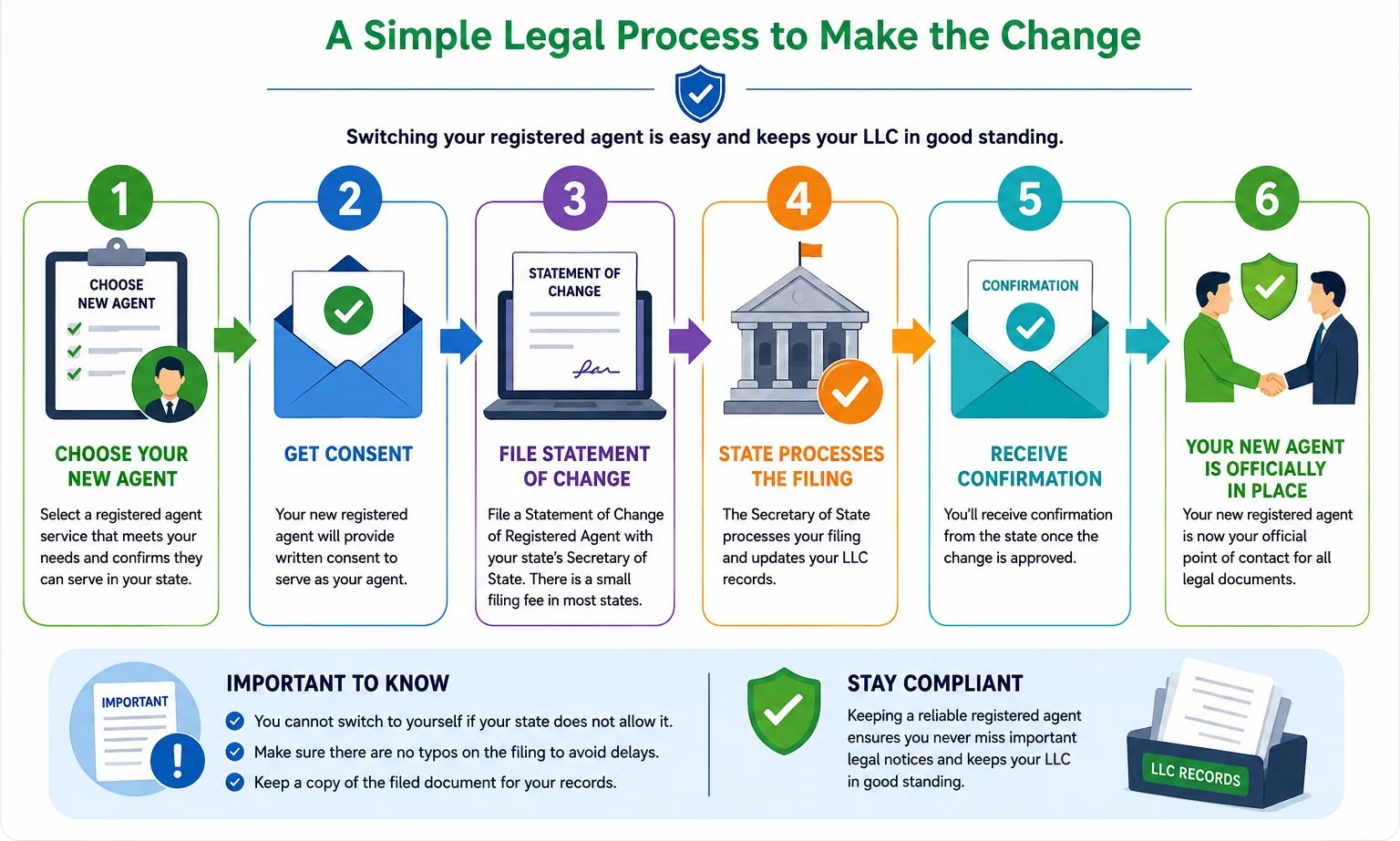
Here is the standard process for switching registered agents in most states. Your mileage may vary, but this covers the essentials.
1. Pick your new registered agent
You have three options: a commercial service (like Inc Authority, Northwest, or LegalZoom), an individual (like an attorney or accountant), or yourself. Your new agent needs a physical street address in the state where you're registered. P.O. boxes won't work [citation:3].
2. File the change form with your state
Every state has its own form for this. It might be called a "Statement of Change of Registered Agent," "Certificate of Change," or "Change of Statutory Agent" [citation:1][citation:6]. You can usually find it on your Secretary of State's website. Just fill it out with your business name, the outgoing agent's details, and the new agent's name and address. In a lot of states, the new agent has to sign the form to show they're taking the job [citation:3].
3. Pay the filing fee
State fees for changing your registered agent run from $0 to around $100. Most land between $10 and $60 [citation:1][citation:2][citation:6]. It really varies. Delaware and Wyoming handle changes quickly and cheaply. But California and New York? Those could take longer and set you back more [citation:2].
4. Submit the filing
Many states let you file online. Others make you mail a physical form or drop it off in person. Online is almost always faster. State processing usually takes 1 to 4 weeks [citation:2].
Here's a quote from the California Secretary of State website that sums it up: "To change your registered agent, you must file a Statement of Information (Form SI-550) or a Certificate of Amendment to your Articles of Incorporation. The new agent must sign the document to indicate their acceptance."
5. Update internal records
Once the state gives the green light, update your operating agreement, bylaws, and any other internal records. Keep a copy of the approved filing with your corporate documents [citation:3].
6. Notify your old agent
After the change is official, let your former registered agent know you've switched. That way, they won't keep billing you for stuff you're not using anymore [citation:2][citation:7].
The golden rule, never have a gap
Your business has to have a registered agent on file at all times, legally. If you drop your current one before the state gets the new one, you’re left with no registered agent at all. That’s a compliance problem, and it can mean fines, losing your good standing, or even the state shutting you down [citation:2][citation:5].
Sequence matters. First, make sure your new agent is ready. Second, file the change with the state. Third, wait for the state to process and confirm it. Fourth, and only then, cancel things with your old agent [citation:2].
If a process server can’t track down a valid agent, they might go the substituted service route through the Secretary of State. And if you never get notified, the court could hit you with a default judgment [citation:3].
Best registered agent services for switching
Here’s how the top services stack up when you need to switch. We’ve focused on the ones we recommend.
| Service | Annual Price | Switch Process | Best For |
|---|---|---|---|
| Inc Authority | $0 (first year) | They handle the filing | Anyone who wants a free first year |
| Northwest Registered Agent | $125+ | They handle the filing | Privacy and service quality |
| ZenBusiness | $99+ | They handle the filing | Ease of use and dashboard |
| Bizee | $119+ | They handle the filing | simple pricing |
| LegalZoom | $249+ | They handle the filing | Well-known brand |
We like Inc Authority for this. Their free first-year registered agent service makes switching a no-brainer. They file the paperwork for you, so you don't have to figure out your state's specific form. Their customer support is responsive, and they handle all the compliance headaches [citation:2]. Northwest is also excellent, especially for privacy (they're known for not selling your data). ZenBusiness and Bizee are solid choices, too, with user-friendly platforms. LegalZoom is the more expensive option, but they're reliable if you prefer a household name.
If you’re stuck choosing between specific providers, our comparison guides have you covered. Check out our Inc Authority vs. ZenBusiness or Northwest Registered Agent review for the nitty gritty.
Most people don't need to switch agents, but if you're relocating, want more privacy, or just expect better service, it's simple to do [citation:1].
Frequently asked questions
Yes, you can swap out your registered agent whenever you need to. Just get the new one on file with the state before you drop the old one. There’s no waiting period or specific window you have to hit [citation:1][citation:2].
Changing your registered agent costs two things: the state filing fee and your new agent’s service fee. The state fee usually runs from $0 to $60. Professional services charge yearly, and some, like Inc Authority, start at $0 for the first year.
If you don’t have a registered agent, your business loses its “good standing” status. You could get fined, miss important tax or legal notices, and in some cases, your state might just dissolve your LLC or corporation [citation:1][citation:3].