Registered agent vs virtual address
Summary: You're legally required to have a registered agent who can accept lawsuits for you. A virtual address is just for mail and privacy. If you want to keep your home address off public records, you need both. They're not the same thing.
Contents
Here's the thing: founders mix these up all the time. They aren't interchangeable. One is legally required for every LLC. The other? Optional, but smart. And if you use a virtual address as your registered agent, you could miss a lawsuit.
Here's the difference, so you don't make that mistake.
Quick answer
| Feature | Registered Agent | Virtual Address |
|---|---|---|
| Purpose | Accepts legal service of process (lawsuits) | Receives business mail and has privacy |
| Legally Required? | Yes (every LLC must have one) | No (optional) |
| Physical Presence Required? | Yes (must be available during business hours) | No (mail scanning is enough) |
| Typical Cost | $99-$299/year | $50-$200/year |
| Can Accept Lawsuits? | Yes | No (unless also a registered agent) |
| Can Accept General Mail? | Usually yes | Yes |
| Keeps Your Home Address Private? | Yes (for legal filings) | Yes (for business mail) |
The short version: the law says you need a registered agent. A virtual address is for privacy. You can use both, or you can pick a registered agent that also takes mail. But a virtual address can't serve as your registered agent unless the provider actually offers both.
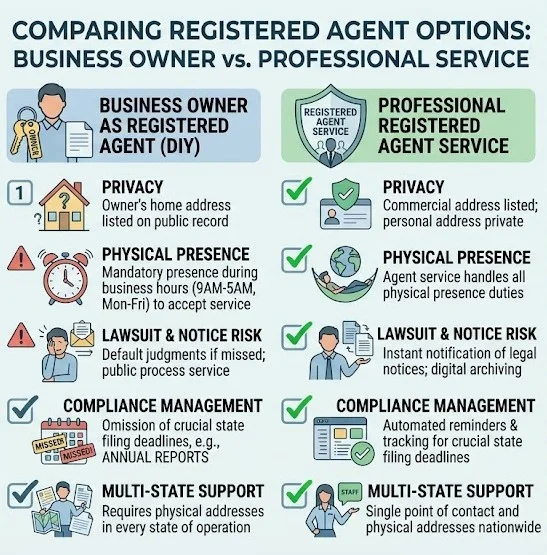
What is a registered agent?
A registered agent is a person or company your LLC picks to accept legal service of process. In plain terms, it's someone who gets sued on your behalf. If someone sues your company, the court papers go to your registered agent. They have to be physically there during normal business hours (9-5) to accept delivery.
Every state makes every LLC have a registered agent with a real street address in that state. No PO boxes. And you can't use a virtual address unless the provider is also your registered agent. Knowing the difference between a registered agent and a business owner is a good place to start.
Your registered agent's address becomes public record. Anyone can look it up on the Secretary of State website. That's why a lot of founders hire a professional registered agent service instead of acting as their own agent.
If you're the registered agent yourself, you have to be at your business address during business hours. For a remote founder, that's basically impossible. Can you switch registered agents covers the process if you change your mind later.
What is a virtual address?
A virtual address is a commercial street address you use for business mail. It's not a PO box. It's a real physical address with a suite number. The provider gets your mail, scans the envelopes, and lets you see them online. You can open, forward, or shred each piece.
Virtual addresses aren't required by law. You don't need one. But they're great for privacy. How to use a virtual address for LLC privacy breaks down the benefits.
Most virtual address providers make you fill out USPS Form 1583. It's a federal thing. They have to verify who you are before they can take mail for you.
A virtual address alone can't accept legal service. If someone sues your LLC and the papers show up at your virtual address, the provider will turn them away. They're not authorized to accept lawsuits.
Key differences
1. Legal requirement
A registered agent is required by law in every state. Your LLC can't exist without one. A virtual address? That's optional. You can run a business without one, though keeping your address private is harder.
2. Function
Registered agents accept lawsuits and official government notices. Virtual addresses take general business mail, packages, and correspondence. One handles legal emergencies. The other is for everyday mail.
3. Physical presence
Registered agents have to be there in person during business hours to take delivery. With a virtual address, you can scan and forward mail without anyone on site. That's the big difference.
4. Public record
Both can keep your home address private. But only the registered agent's address shows up on state records. The virtual address is what people see on your website and marketing materials. So if you want to hide your home address, you need both.
5. Cost
Registered agent services usually run $99-$299 a year. Virtual address services? $50-$200 a year. And you can find bundled services that give you both for $100-$250 annually.
When you need both
You need both for complete privacy. The registered agent keeps your home address off public state records. And the virtual address keeps it off your website, your invoices, and your business mail.
Here's a setup that works:
- Use a registered agent service for your state filings. That way your home address won't show up on the Secretary of State website.
- Use a virtual address for your business mail. That way your home address won't show up on your website, business cards, or marketing materials.
- Stick with the same provider if they do both. A lot of them do. Northwest Registered Agent, for instance, handles both.
If you run a remote company, you probably need both. You can't act as your own registered agent since you're not physically in the state during business hours. And you don't want your home address getting mail. How to keep your LLC compliant walks through what both services require on an ongoing basis.
Can one replace the other?
No. They can't replace each other. Here's why:
Can you use a virtual address as a registered agent? Nope. A virtual address provider won't take legal service unless they're specifically authorized to. They scan your mail. They don't accept lawsuits. So if you get sued and the papers show up at your virtual address, you could miss the whole thing. Next thing you know, there's a default judgment against you. And that's bad.
Can I use a registered agent as a virtual address? Sometimes. Some registered agent services take general mail too. But that's not really what they're for. They might forward your mail, but scanning and forwarding usually costs extra. A dedicated virtual address service is usually cheaper.
You can use a registered agent service that offers mail forwarding. But a dedicated virtual address service will have better scanning, better dashboard, and better pricing for mail handling.
Bottom line: you need a registered agent. A virtual address helps, but it's not required. If you want privacy, get both.
Cost comparison
| Service Type | Typical Annual Cost | What You Get | Best Provider |
|---|---|---|---|
| Registered Agent Only | $99-$299 | Legal service acceptance, physical address | Northwest, ZenBusiness, Bizee |
| Virtual Address Only | $50-$200 | Mail scanning, forwarding, dashboard | iPostal1, Traveling Mailbox |
| Combined Service | $100-$250 | Legal acceptance + mail scanning | Northwest Registered Agent, Inc Authority |
LegalZoom vs Northwest Registered Agent breaks down how each one handles these services. Northwest is great for privacy. LegalZoom costs more, but you get attorney consultations.
Best combined services
If you want a single provider for your registered agent and your virtual address, here are the best choices:
- Northwest Registered Agent – $125/year. You get registered agent service and mail scanning. They're known for privacy protection. They won't sell your data. Northwest Registered Agent review covers how they put privacy first.
- Inc Authority – First year is free, then it's $99 a year. They throw in a registered agent. You can get mail forwarding too, but it's pretty limited next to what a dedicated virtual address service gives you. Inc Authority review goes over their free formation deal.
- ZenBusiness – Free for the first year ($119/year after). Comes with a registered agent. They do mail scanning through a partner. ZenBusiness review breaks down what they offer.
- Bizee – First year is free, then it's $119 a year. You get a registered agent too. Mail forwarding? That's an add on. Bizee review breaks down what they charge.
Inc Authority vs ZenBusiness, that comparison can help you pick between two free formation options. Both throw in registered agent service with their free packages.
If you just want a virtual address and no registered agent service, check out iPostal1 or Traveling Mailbox. They start at $10-$20/month and offer excellent mail scanning features. But you'll still need a separate registered agent service.
Bizee vs Northwest Registered Agent puts a free formation service up against a paid one that focuses on privacy. Northwest throws in registered agent and mail handling too.
For most founders, the best move is a registered agent service that also does mail forwarding. That way you're not juggling two providers. Northwest is the gold standard for privacy. ZenBusiness and Bizee are good free options if you're on a budget.
Frequently asked questions
No. A virtual address can't accept legal service of process (lawsuits). You need a registered agent who has a physical presence during business hours. Some providers offer both services, but the virtual address alone won't work.
You need a registered agent by law. A virtual address? That's optional, but we recommend it for privacy. If you want your home address off public records and away from customers, you need both.
Sometimes. A lot of registered agent services offer mail forwarding as an add on. Some, like Northwest, include mail scanning in their service. But not all of them do. Check with your provider before you assume they handle mail.
A combined service from Northwest ($125/year) is cheaper than buying two separate services ($99-$299 + $50-$200). Northwest offers both registered agent and mail scanning for one price.
You can be your own registered agent if you have a physical address in the state where your LLC is formed. But you have to be available during business hours. If you're using a virtual address, that won't work for registered agent service.