Registered agent vs. business owner, which should you choose?
Contents
Every LLC and corporation in the US has to name a Registered Agent by law. That agent is the official go to for lawsuit papers, state tax mail, and annual compliance notices. Can you switch registered agents? Sure, but picking the right one upfront beats dealing with the headache later.
Entrepreneurs have to make a big call here: do you act as your own registered agent, or do you bring in a third party service? The Texas Secretary of State puts it this way: "A registered agent is a person or entity that accepts service of process on behalf of a business entity. The agent must have a physical address in Texas."
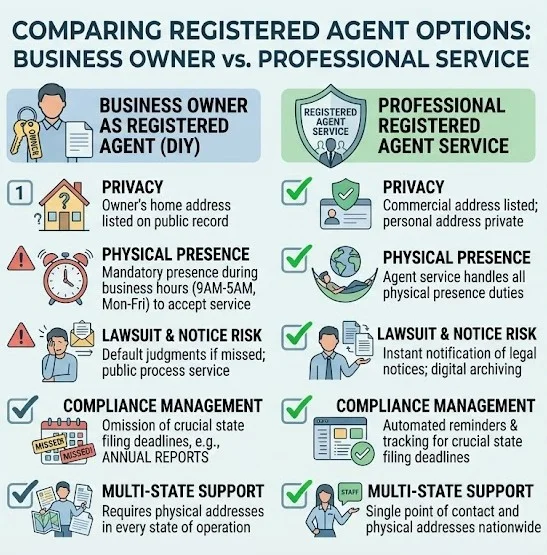
Definitional roles & legal mechanics
To figure out this decision, you have to separate what an owner does from what a statutory agent does. Inc Authority and other formation services offer registered agent options, but knowing the difference helps you pick what's right.
Business Owner. We hold equity, get profit distributions, and keep the main management or voting power. That ownership comes with economic rights and serious top level duties.
Registered Agent. It’s a purely administrative, statutory role under state corporation law. The agent has no equity, legal authority, or managerial power over the business. Their only job is to keep a physical street address in the state of incorporation and be there during normal business hours, 9 to 5, to accept official legal and government mail. The New York Department of State puts it this way: "The registered agent is the person or entity designated to receive service of process on behalf of the LLC."
Option a, business owner acting as registered agent
In almost every state, you can be your own registered agent if you’re 18 or older and live where you formed the business. How to use a virtual address for LLC privacy works well if you’d rather keep your home address off the public record.
Core Advantages. You cut out third-party service fees, which usually run $100 to $300 a year per state. Notices and tax forms land right in your inbox, no waiting on someone else to process the mail. And you skip the hassle of juggling outside contracts or portal logins.
important Disadvantages. Losing address privacy entirely is the biggest issue. Your registered agent’s physical street address becomes part of the permanent public record. If you work from home, that personal residence is searchable online, which invites spam, solicitors, and real safety concerns. The rule that the agent must be physically present at that address every business day from 9 to 5 is strict. That makes it tough for a single operator to travel or take a vacation without worrying about missed deliveries. If your business gets sued, a sheriff or process server will show up at the listed address. When that’s your home, it happens right in front of your family and neighbors. And if you miss that process server because you’re away or sick, you could face a default judgment against the LLC. That wipes out your legal defense before you even know about the lawsuit.
Option b, hiring a professional commercial registered agent service
A commercial registered agent is a licensed corporate entity or legal service provider that’s authorized to receive official correspondence in one or multiple states. Comparing Inc Authority vs. ZenBusiness can help you weigh different registered agent options.
Core Advantages. Complete privacy shielding means the commercial agent's corporate address is listed on public filings, keeping your personal residential address off public databases. Unrestricted operational freedom lets you travel, work remote, or work odd hours without breaking any rules. You can expand into multiple states too, getting a compliant physical address in each one from a single dashboard. We also handle compliance monitoring and digital archiving, so we scan incoming legal notices into secure online portals and send you automated reminders for annual reports and franchise tax dates.
important Disadvantages. You’re looking at roughly $100 to $300 per state, every year, just to keep things running. So if you’re in ten states, that’s $1,000 to $3,000 in agent fees annually. Plus, you’re stuck relying on a third party to scan, upload, and flag urgent court documents for you. If that notification slips through, you could miss a legal deadline entirely.
Exhaustive comparative decision matrix
Here's how the two options stack up side by side. How to keep your LLC compliant depends partly on having a reliable registered agent arrangement.
| Performance Metric | Option A: Owner Acts as Agent | Option B: Professional Agent Service |
|---|---|---|
| Annual Direct Cost | $0.00 | $100 – $300 / year |
| Personal Home Privacy | ❌ Exposed (Publicly searchable) | Protected (Agent address listed) |
| Physical Presence Burden | ❌ High (Must be present Mon–Fri, 9–5) | Zero (Vendor maintains office staff) |
| Lawsuit Delivery Venue | ❌ Home porch or customer-facing office | Vendor's commercial office |
| Multi-State Support | ❌ Requires home addresses in every state | Unified single-vendor portal |
| Compliance Management | ❌ Owner must manually track deadlines | Automated deadline tracking & scans |
| Default Judgment Risk | Moderate–High (If traveling or sick) | Very Low (Contracted SLA) |
Strategic recommendations & decision framework
Choose Owner as Agent if: Capital's tight, like a $0 budget. You've got a fixed storefront. The owner's there all the time during business hours. And you only operate in one state.
Hire Professional Service if: You care about keeping your home address private. The business runs online or from home. The owner travels a lot or works remotely. The business works across multiple states.
Strategic Action Plan. For bootstrapped local retailers with a commercial brick-and-mortar storefront open Monday through Friday from 9 to 5, serving as your own agent presents minimal extra risk. For home-based businesses, remote teams, and e-commerce, hire a commercial registered agent. The cost ($100-$200 per year) is negligible compared to the privacy risks of making your personal residence address part of the public registry. Mid-stream migration is possible, a company can transition from an individual agent to a commercial service at any time by filing a Change of Registered Agent form with the Secretary of State along with the state filing fee, typically $10 to $50.
Frequently asked questions
Yes, you just need to be 18 or older and have a real street address in the state where you're forming the company. You also have to be around during normal business hours to accept legal papers. But heads up, your home address will be out there for anyone to see.
Professional registered agent services usually run you $100 to $300 a year. Some formation services, like Inc Authority, throw in the first year free, so you save a bit upfront.
If you miss a service of process, the plaintiff can file for a default judgment against your LLC. That means you lose the case automatically, no chance to defend yourself. It's one of the biggest risks of being your own agent.