Nevada vs wyoming llc, asset protection, privacy, and costs
Contents
When entrepreneurs look past their home state lines for a remote jurisdiction to house a LLC, two titans invariably emerge: Nevada and Wyoming.
Most comparison pieces hit the same tired notes, Wyoming’s cheap, Nevada’s got the flash. But dig into the statutory details, the structural mechanics, and what you actually get for what you pay over time, and you’ll see these two states are running completely different plays on risk.
If you’re trying to figure out where to plant your flag, we’ve dug into the hidden mechanics, the statutory fine print, and the real world differences most advisors skip. For a wider look at the whole thing, our home state vs Wyoming LLC comparison gives you more context.
The origin story, the innovator vs. the aggressive scaler
To see how these states protect you, you have to check their legal DNA.
Wyoming (The Pioneer): Wyoming came up with the American LLC back in 1977, and it did it specifically so small business owners could get corporate style asset protection without all the corporate red tape. The state's laws are lean, they've been tested in court a lot, and they're built to keep paperwork to a minimum.
Nevada (The Fortification): Nevada looked at Wyoming's blueprint and scaled it into an aggressive corporate fortress. Its legal framework is built for high-net-worth protection, complex multi-entity setups, and serious litigation deterrence.
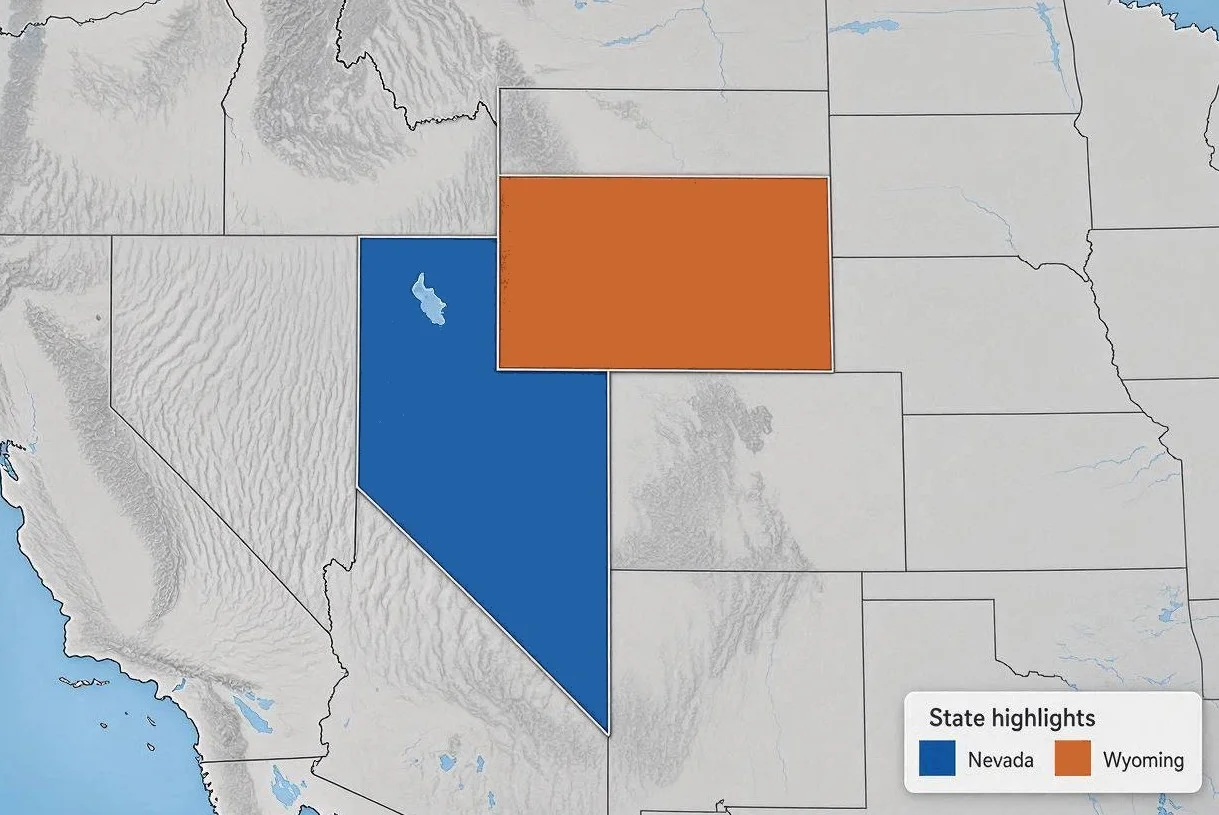
The asset protection mechanics, where the statutes diverge
Both states are celebrated for giving charging order protection, that legal rule where if you get sued personally, outside the business, a creditor can't grab your company's physical stuff or force a liquidation. They can only sit and wait for a formal profit distribution. But the way that actually plays out in practice? That’s where they split.
Wyoming’s Absolute Statutory Exclusion: Wyoming statute says a charging order is the only remedy a judgment creditor gets, and it flat out stops courts from allowing foreclosure or other equitable moves, even for single member LLCs. The wording leaves almost no wiggle room for a judge to interpret, so plaintiffs trying to pierce or game the system have a really tough time.
Nevada’s Broad Corporate Bridge: Nevada’s got elite charging order protections too, but it takes things a step further by linking those protections across entity types, so they’ve historically stretched smoothly from LLCs into corporate shares. It’s also famous for Series LLCs, which let one master LLC spin off legally separate "cells" or series. If you’re looking to isolate liability across several different properties or e-commerce brands under a single roof, Nevada’s structural setup is seriously powerful.
The privacy paradox, true anonymity vs. public disclosure
Privacy is a big reason founders pick one state over the other, but what actually happens with your data behind the scenes couldn’t be more different.
Wyoming (Native Anonymity): Wyoming doesn’t require LLC member or manager names and addresses on public formation papers. The state database just grabs the organizer and registered agent, so you get real structural privacy from day one, no tricky legal work needed.
Nevada (The Managed Shield): Nevada makes you file an Initial List of Managers or Members right off the bat. The state's online portal gives you some cover, but real privacy here usually means going with a "manager-managed" setup and layering in nominee services or a commercial registered agent. That keeps your name out of the public data scrapers.
For those who care about privacy, Northwest Registered Agent is a solid pick because they really lock things down. Inc Authority’s free package gets you going without much hassle, though their privacy stuff is pretty basic.
The financial reality, upfront friction vs. sustained overhead
The most glaring gap between the two states is what they charge you to exist year after year.
The Wyoming Lean Model:
- Upfront: about $100 to $104 to file online.
- Ongoing: an annual report and license tax that starts at a flat $60 per year for standard small business asset tiers.
The Nevada Heavyweight Model:
- Upfront: you’re looking at $425 to get going. That’s $75 for the Articles, $150 for the initial list, and a required $200 state business license fee.
- Ongoing: Every year, you have to shell out $350 to renew your annual list and business license, that’s $150 plus $200. Miss that window, and the penalties kick in right away.
For a lean operation, Wyoming’s cost structure is hard to beat. But if you’re setting up something complex with high-value assets, that premium might just be worth it.
| Factor | Wyoming LLC | Nevada LLC |
|---|---|---|
| Initial Filing Cost | $100 | $425 |
| Annual State Fees | $60 | $350 |
| Member Privacy | Native (names not required) | Managed (initial list required) |
| Charging Order Protection | Exclusive remedy (strong) | Broad (plus Series LLC) |
| Series LLC Allowed | No | Yes |
The verdict, which fortress do you need?
Wyoming’s the smarter call for 80% of founders. That absolute charging order protection, the built in privacy, and $60 a year in overhead? Tough to beat. Nevada only makes sense if you're looking for a Series LLC, or you’re big enough that the extra costs just don’t matter.
Choose a wyoming LLC if,
- You want bulletproof single-member asset protection and true native privacy, without paying heavy annual extortion fees to the state.
- You are running a lean operation, a digital agency, or a holding company where keeping ongoing overhead to a minimal $60/year matters to your bottom line.
Our Wyoming LLC formation breakdown gets into the nitty gritty of how to kick things off.
Choose a nevada LLC if,
- You need advanced asset protection architecture, like a Series LLC, to keep multiple high-risk assets or commercial projects separate.
- You operate at a scale where eating a $350 yearly maintenance fee is nothing next to using Nevada’s tough litigation-deterrent laws and its rules for bridging multiple entities.
For those leaning towards Nevada, our Nevada LLC guide walks you through the filing steps and what you’ll need to keep up with later.
If you're still on the fence, our best LLC service for real estate piece could help you pick based on your field.
Frequently asked questions
Both offer strong protection. Wyoming’s charging order statute is exceptionally clear and exclusive, which makes it a go to for single member LLCs. Nevada gives you broader protections that can stretch to other entity types, and it allows Series LLCs. That’s a big deal if you’re dealing with complex structures.
Wyoming is cheaper. Initial filing costs are around $100, and annual fees are just $60. Nevada costs $425 to start and $350 per year to maintain.
Not as easily as in Wyoming. Nevada makes you file an initial list of members or managers. You could set it up as manager managed and use a pro registered agent to keep your name off the public record, but that’s not the same as Wyoming’s built in anonymity.
A Series LLC lets you set up multiple "series" or cells under one master LLC, and each one keeps its own assets and liabilities. That’s handy if you’re into real estate or run an e-commerce brand with separate product lines. Nevada’s one of the few states that explicitly lets you do this.